


Adapted from a press release by Penn State
Large wildfires are becoming more frequent in the eastern US, accelerating risks to people, property, and ecosystems. To help address these threats, Winslow Hansen, an ecologist at Cary Institute of Ecosystem Studies, will bring his expertise in western fires to the newly formed Eastern Fire Network (EFNet).
Led by Erica Smithwick from Penn State’s Department of Geography, EFNet has secured a $1.74 million, three-year grant to convene scholars and establish a fire research agenda and big-picture goals for future studies focused on wildfire in the eastern US.
“We think of wildfires happening mainly in the western states,” said Smithwick, a longtime fire researcher. “But fire conditions are changing more quickly in eastern states than we anticipated.”
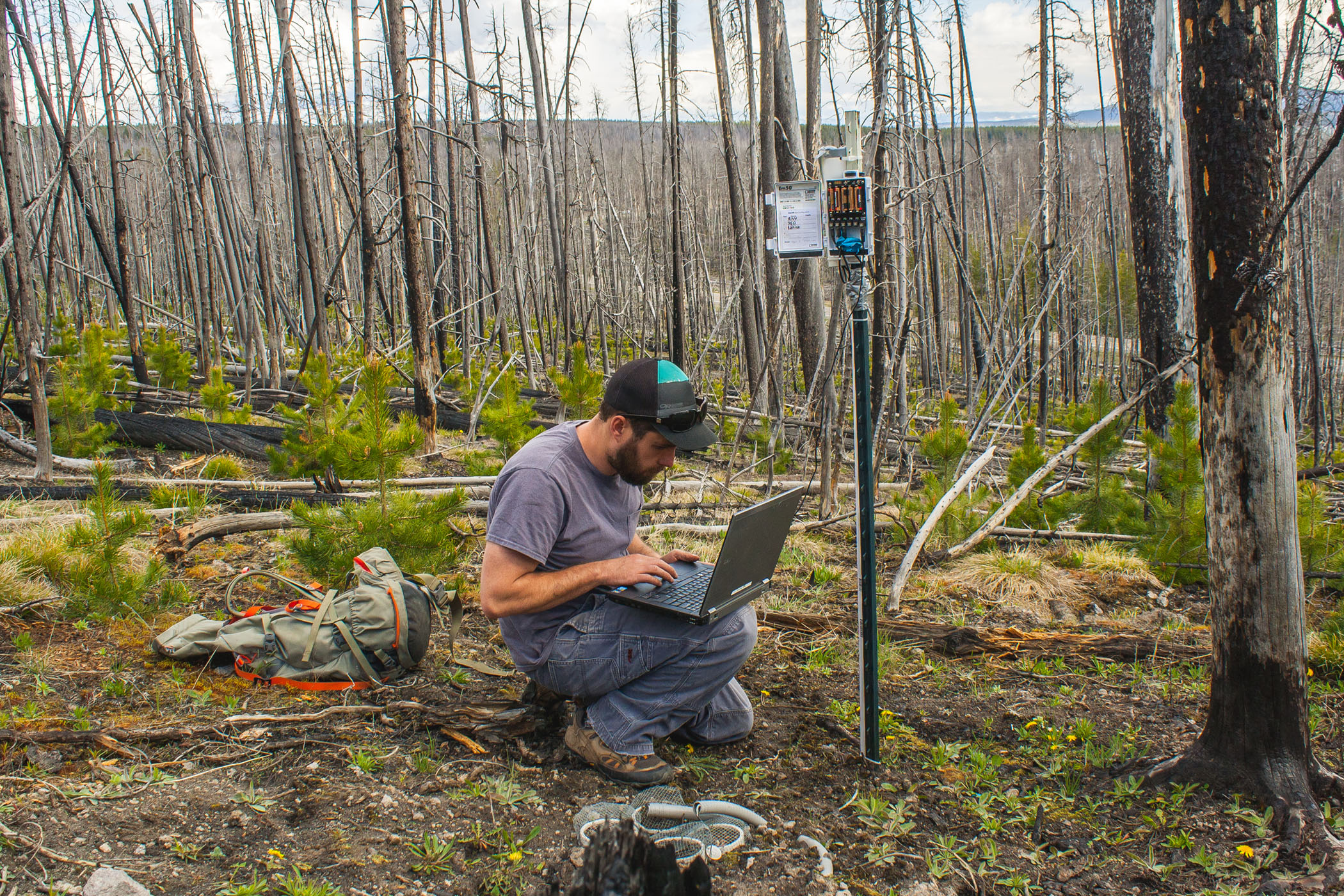
EFNet will build on prior wildfire research in western states, including that of the Western Fire and Forest Resilience Collaborative (WFFRC). Directed by Hansen, WFFRC is a multi-institute initiative working to develop actionable fire science in the western US in partnership with land managers. Hansen, a co-principal investigator on EFNet, will serve as liaison between the two organizations to help translate WFFRC’s discoveries and custom-made tools into the eastern context.
“We’ve made tremendous progress in understanding the western US fire crisis,” said Hansen. “These lessons can accelerate advances in eastern forests.”
Changing conditions in the Northeast
“In the Northeast, we know relatively less about historical fires and what the future might hold compared to our western forests,” Hansen said.
Over the last century, Northeast forests weren’t thought to be as susceptible to burning, he added. But that’s changing with drier conditions, including autumn droughts that appear to be more numerous and extreme.
In 2023, 19 states known as the Eastern Area saw 56% more acres burned versus an average year, according to the National Interagency Fire Center. Severe conditions persisted into 2024, when wildfires claimed 207,000 acres in the area, the center reported.
Hazards in the Northeast are especially worrisome given dense populations and the close integration of urban communities, infrastructure and forests, said Smithwick. In fact, she said, the region has the most US residents living in fire-prone forests.
“Even small fires can have large impacts in ecological and property damage, health hazards from wildfire smoke and the economy,” said Smithwick. “It doesn’t take a big fire to destroy lives.”
Working toward solutions and safer communities
EFNet will be the first organization of its kind centering on the East. With focuses spanning biology, ecology, social services and beyond, participants will identify questions to inform and structure longer-term fire studies in the region.
“Environmental hazards, social systems and governance are intertwined,” Smithwick said. “By bringing people together across these connected areas, we can develop capacity for solutions — for safer communities — in a time of uncertainty.”
Core themes for the work include overall regional conditions for fire, seasonal droughts, predictive modeling for fire risks, and specific vulnerabilities confronting communities. For example, a research team at Penn State is evaluating perceptions of wildfire smoke risks and responses in the Northeast, where long-transported smoke is exacerbating air-quality issues.
Plans for EFNet involve regular meetings, workshops and in-person convenings to help bridge existing networks of fire science and research. Graduate students will have opportunities to join, too.
At the end of three years, the group wants to have developed a “clear research agenda that can move the scientific community forward — for instance, to help graduate students shape dissertations that are most responsive to decision maker needs and rapidly evolving questions,” Hansen said.
“We have this window of opportunity to get ahead of the curve, particularly in the Northeast,” he said, noting that even New York City saw fires in fall 2024 in Central Park and Prospect Park. “It’s critical that we prepare for a wide range of alternate futures.”
The Gordon and Betty Moore Foundation — the primary funder of WFFRC — is funding EFNet in collaboration with the Buckminster Fuller Institute and the NSF through the Fire Science Innovations through Research and Education program.
Other participating institutions are Columbia University, the Tall Timbers nonprofit, the University of Florida and North Carolina State University.
“Together we can set a foundation to understand and predict the biggest threats and how to address them,” said Hansen.


