
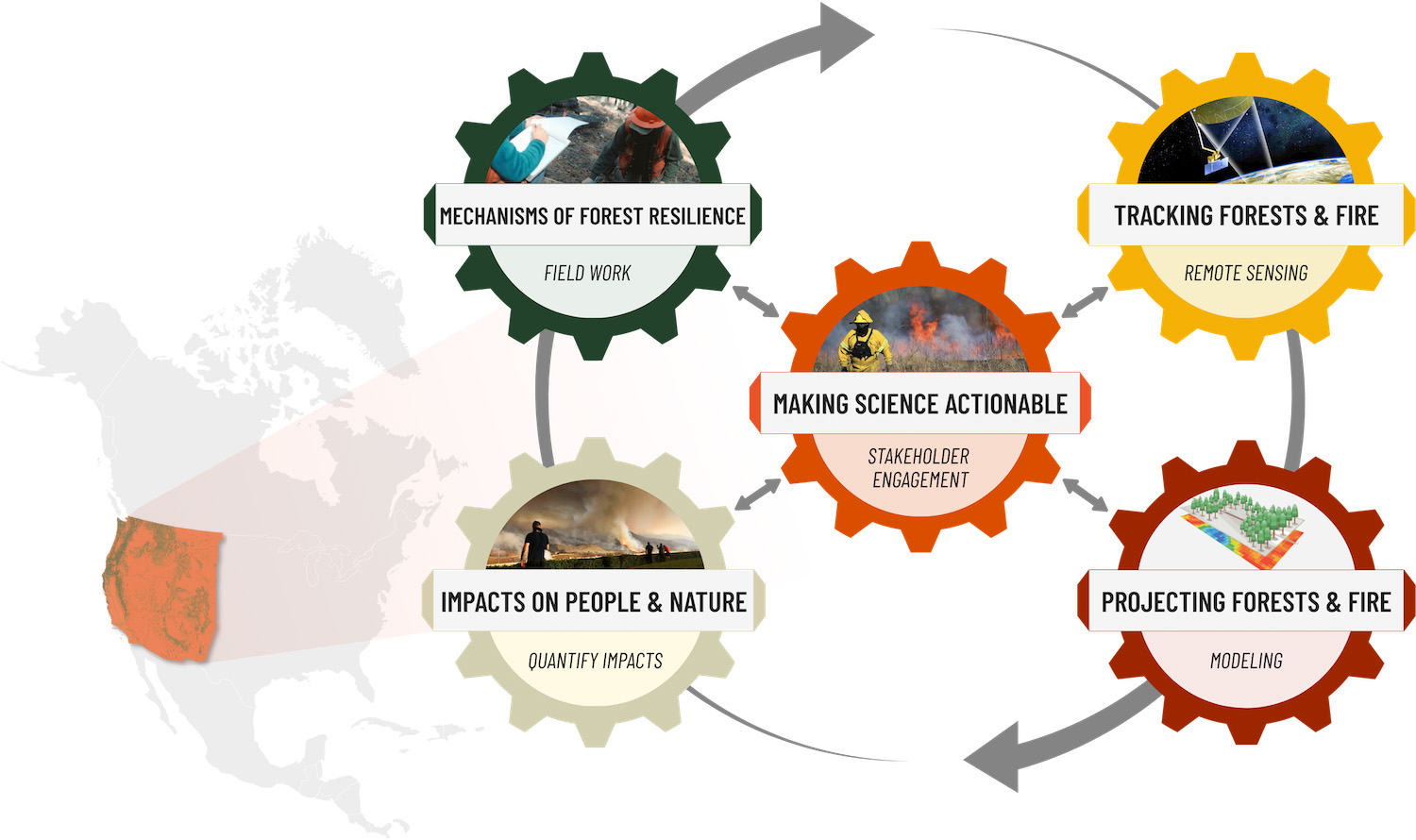
In the western US, climate change and a century of fire suppression have led to rapid increases in the size and severity of forest fires. Managers and policy makers are responsible for safeguarding people, livelihoods, property, and natural resources. This includes managing fire and fuels, monitoring air quality, conserving biodiversity, and tracking the land’s ability to sequester carbon.
While unprecedented federal, state, and private resources are available to address the fire crisis – the scope of the problem is so vast that spending must be targeted to ensure multiple goals are met using the best science. Logistical barriers continue to constrain implementation, however, we also still do not know how solutions scale today nor how future climate change will shape outcomes. Effective coordinated strategies will rely on understanding where, when, how, and why ecosystems and fire regimes are changing now and will change in coming decades.
By partnering with the fire-management and policy community, we will co-create and implement a research program that ensures the predictive science of fire ecology and forest resilience is sufficiently mature to support effective strategies to the fire crisis.
Key Objectives
- Making science actionable by ensuring the research agenda is responsive to decision-maker needs and that the best available science guides decision making and adaptation.
- Identify the mechanisms that underpin forest resilience with experiments and field work. Understand and predict where, when, and why the risk of non-reversible forest loss is greatest.
- Track the changing nature of forest conditions and fire regimes in the western US using legacy and state-of-the-art remote sensing platforms. During an era of unprecedented investment in proactive forest management, this will allow us to precisely measure progress.
- Projecting forests and fire by feeding remote sensing data into forest models to determine how current and future stewardship actions may shape future outcomes.
Quantify impacts on people and nature. This includes biodiversity, air quality, carbon storage, and water. Our model will help us better project how and where ecosystem benefits will change, and how they might be impacted by different management strategies.
WFFRC news


Funders

This project is funded in part by the Gordon and Betty Moore Foundation.

This project is funded in part by Lyda Hill Philanthropies.

This project is funded in part by Hearst Foundations
In gratitude to individual donors who have helped support this project.