


Xinghua Cheng is a 2025 participant of the Catskill Science Collaborative Fellowship Program, coordinated by Cary Institute of Ecosystem Studies. The Collaborative offers up to $18,000 in funding for students and their mentors to address research gaps identified by the Department of Environmental Protection, US Geological Survey, and other resource managers.
In the summer of 2025, I had the great opportunity to participate in a fellowship project through the Catskill Science Collaborative. In our project, we examined how shifts in forest phenology (i.e., the timing of tree life cycles) and extreme weather (e.g., droughts and heavy rainfall) influence stream water quality. In particular, we investigated how these factors influence stream nitrate levels of watersheds in the Catskill Mountains that millions of people depend on for drinking water.
Stream nitrate is a form of dissolved nitrogen commonly found in water bodies. It comes from natural sources such as decaying plant tissues, as well as air pollution and other human activities like the use of fertilizer. High stream nitrate concentration can contaminate drinking water supplies, contribute to the formation of harmful algal blooms, and harm the health of people and wildlife.
Because of climate change, plants have been altering the timing when they start to grow leaves and flowers in spring and change leaf color and drop leaves in fall. Scientific studies found that due to continuous warming, trees in the Northeast develop their leaves and flowers earlier in the spring, and drop their leaves later in the fall than they did decades ago. Such changes in timing can impact many other species who depend on the trees, and even the environment around the trees. For example, the timing of leaf senescence determines when fresh leaf litter enters waters and soils, thereby influencing stream nitrate levels and the cycling of other nutrients.
Extreme hydroclimatic events such as droughts and heavy rainfall can affect stream nitrate concentrations, too. For instance, heavy rainfall may wash more nitrogen from soils to streams. Heavy rainfall in the spring can also hinder trees’ growth and delay when the trees put their leaves out. A shorter leaf-growing period would reduce the amount of nitrogen taken up by trees.
We wanted to see if we could detect these and other trends in stream nitrate data. After checking water quality data at all sampling sites in the Catskill/Delaware watershed system, which supplies 90% of New York City’s water, we selected 21 stream monitoring sites with long-term nitrate records whose watersheds were mostly covered with deciduous forests. These sites were located within three watersheds: Neversink, Rondout, and Ashokan in the southeastern Catskill region (shown in the map below). We calculated monthly nitrate concentration at each site and examined the patterns among months and changes in concentration over the past 25 years.
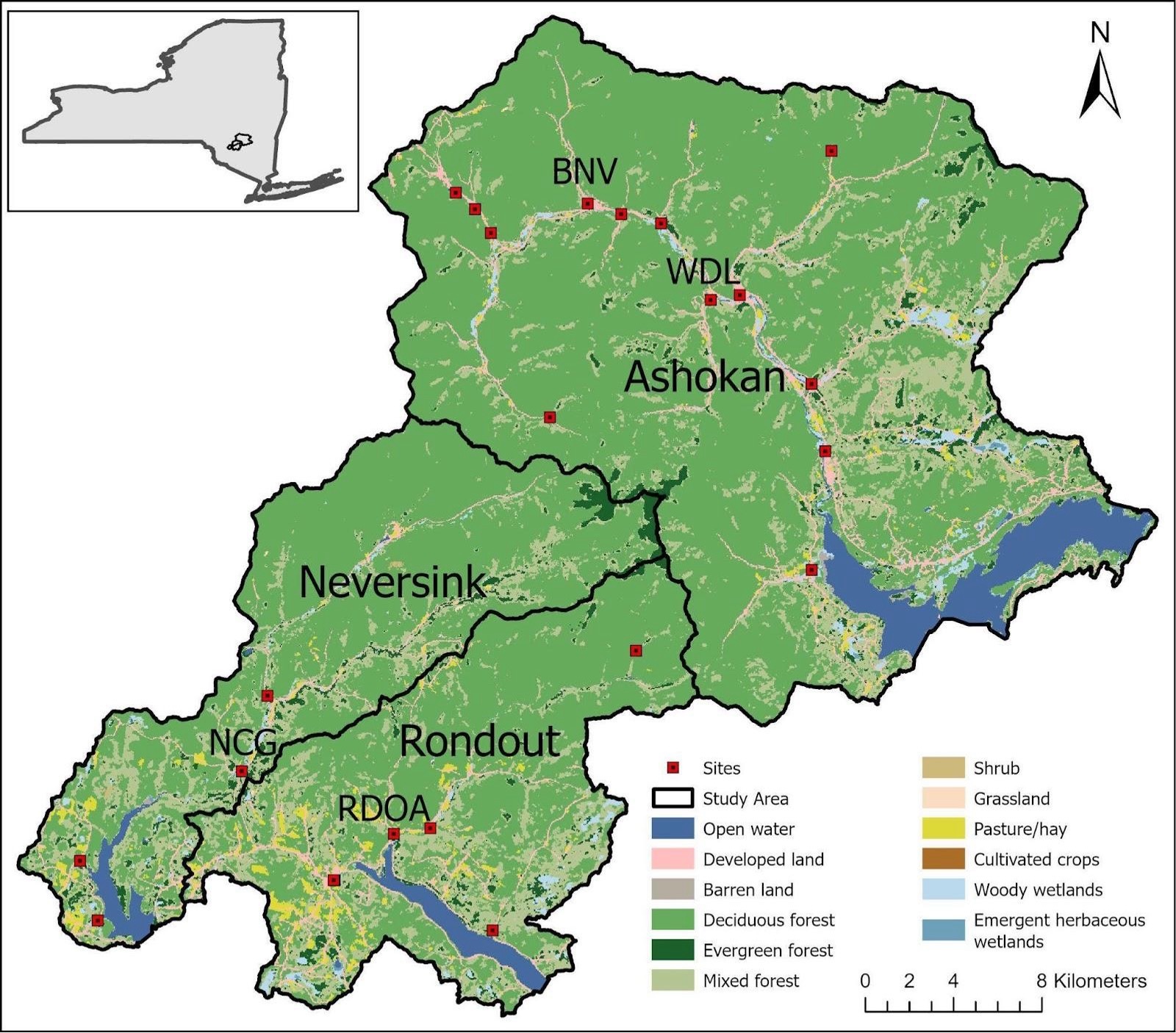
We were excited to see that nitrate concentration levels at all our sites showed generally similar seasonal patterns, which we think may be associated with forest seasonal activities, droughts, and heavy rainfall. Stream nitrate was high in winter and early spring — perhaps linked to leaf litter and high precipitation — whereas stream nitrate was lower during the tree growing period, when trees absorb nitrogen.
We further found that the droughts in early spring were linked with lower stream nitrate concentration in April. This is because the reduced streamflow decreases the nitrogen transport from soil to stream. For the high nitrate concentration in early winter, we found that droughts in late spring and heavy rainfall in autumn had strong positive effects. The possible reason is that the spring droughts can accelerate leaf fall and reduce the nitrogen uptake by trees, while the heavy autumn rainfall increases runoff and brings more decaying leaf litter into the stream.
Interestingly, we did not find evidence that forest phenological shifts from climate change are impacting stream nitrate concentration. In fact, when we analyzed shifts in forest phenology from 2001 to 2022, we found that some regions had delayed greenup and earlier dormancy dates for most deciduous forests — the opposite of what’s generally expected under climate change. We think the delayed spring greenup may be attributed to the cooling effect or stress from more heavy rainfall in the spring, and that more droughts and heavy rainfall may make trees stop growing and advance the dormancy stage.
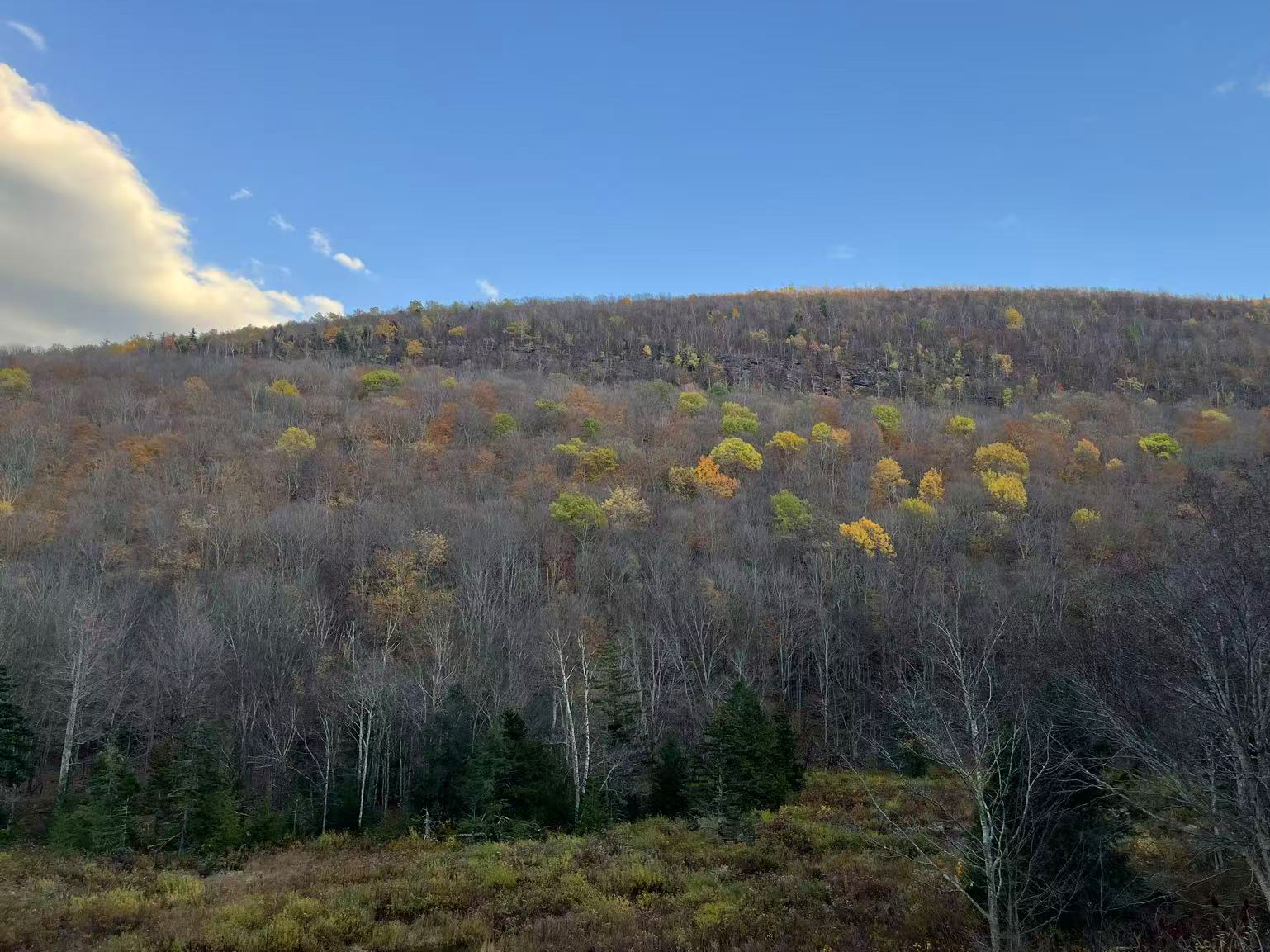
During the project, I learned a lot about water quality measurements, forest ecology and ecohydrology. Our team — including myself, my project mentors Dr. Yingying Xie, Dr. James Knighton, and three research scientists from NYC Department of Environmental Protection (Rakesh Gelda, Rajith Mukundan, and Sijal Dangol) had regular meetings to discuss project progress and exchange research ideas. Over the course of this project, the mentor and resource managers have passed down some of their research wisdom.
For example, Yingying shared tips for taking notes, data quantification, and quality control with me; James helped me understand the hydrological process and nutrient cycling within small watersheds; Rakesh, Rajith, and Sijal nicely guided me in understanding ecohydrological processes and water resources management. During the summer, I was able to visit Catskills and explore the beautiful scenery. This project also provided me with an opportunity to share my research results with the public during the Catskill Environmental Research & Monitoring Conference. The experience in this project largely inspired me to study ecohydrology, because it showed me how humans are inherently connected to water, plants, and energy.
This research improves our understanding of nitrogen cycling in forested mountain watersheds under a changing climate. The findings from this project could benefit the people who rely on the watershed for their drinking water. Planting vegetation along stream banks can help "trap" nitrates before they reach the water. More monitoring should be deployed to provide continuous, real-time data for public warnings.
Xinghua Cheng is a PhD candidate at the University of Connecticut studying how forest phenology shifts and extreme hydroclimatic events influence stream nitrate concentrations. Working with Dr. Yingying Xie and Dr. James Knighton and Department of Environmental Protection (DEP), he is developing statistical models and spatial maps to support NYC DEP’s water quality conservation efforts.


