


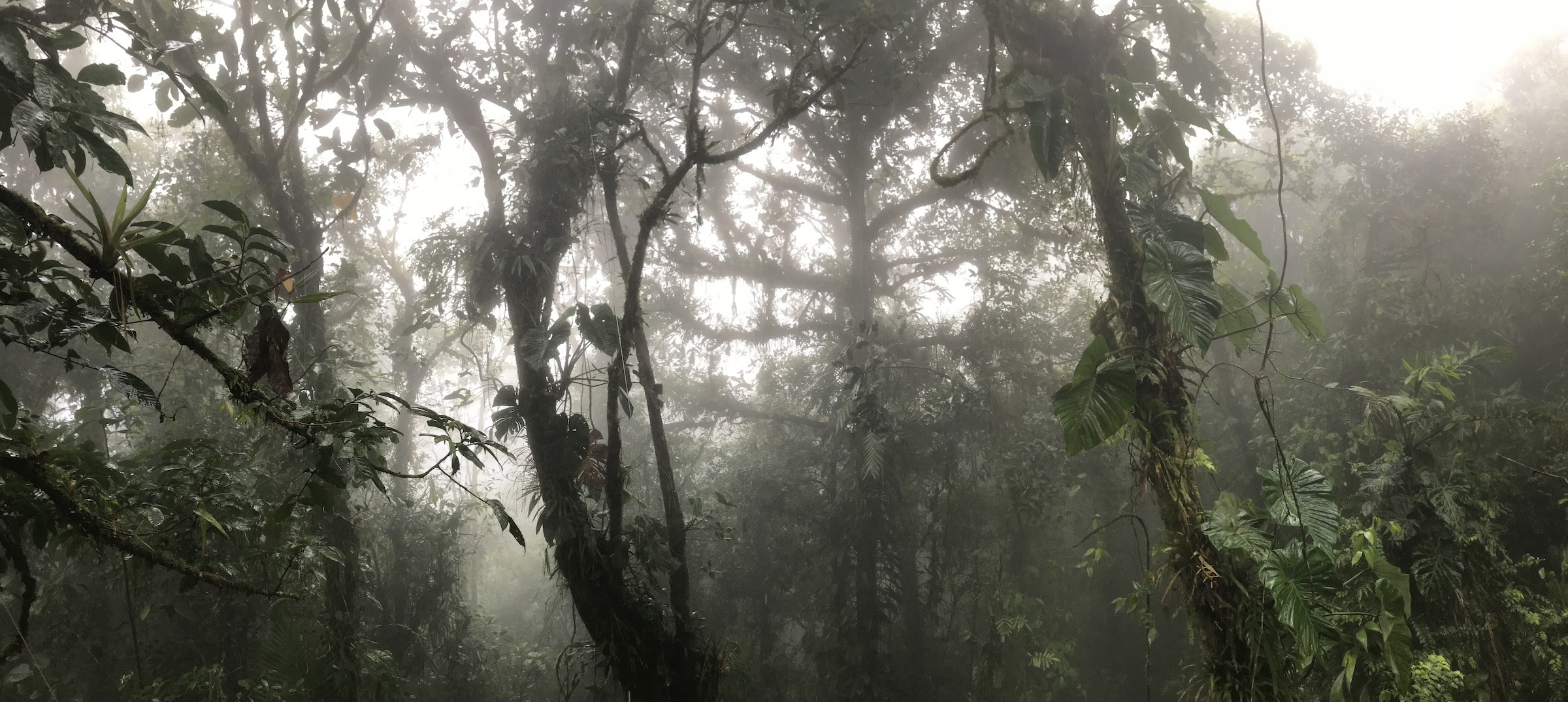
During the wet season in Panama’s Santa Fe National Park, everything seems to be covered in mud — even the tree tops. Mud, moss, and plants wrap around the trees from the base of the trunk to the highest branches. Clumps of wet soil and greenery hang off the boughs like oversized Christmas ornaments. Shiny dark clots glaze tree trunks. This arboreal mud is called canopy soil, and it mostly forms on trees in cool, wet forests like Santa Fe’s cloud forests.
There’s a lot that scientists don’t know about canopy soil, but a new project will start to demystify this suspended substrate. Led by Jane Lucas and Evan Gora of Cary Institute of Ecosystem Studies, along with Michelle Spicer of Lehigh University, the team is investigating the microbes that live in these soils, and what they can teach us about how climate change will impact the microorganisms that keep our world working.
What is canopy soil?
“That’s actually a hard question to answer,” says Jane Lucas, a soil ecologist at Cary Institute, “because there are certain soil scientists who would say canopy soil is not soil.”
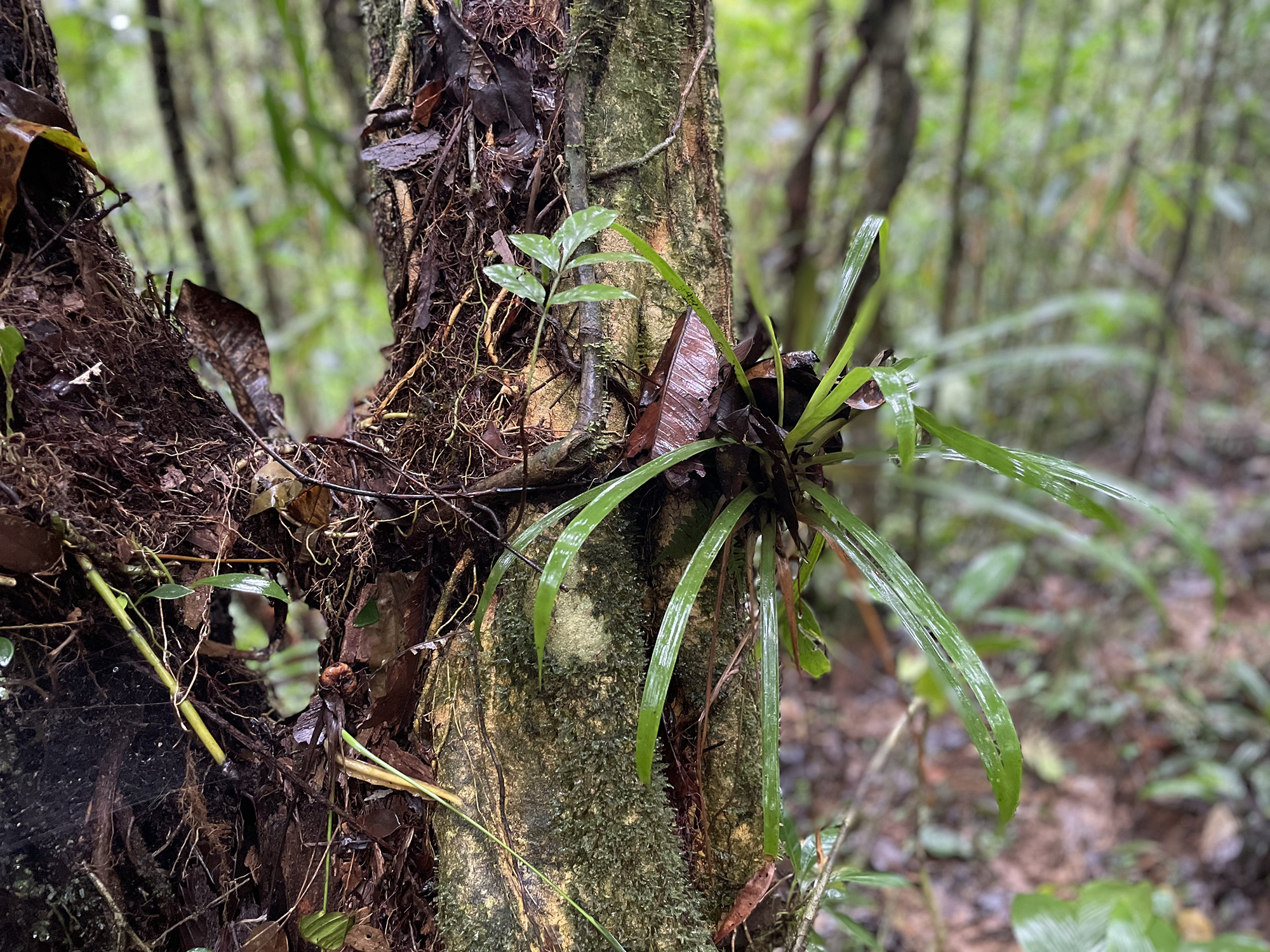
On the ground, soil is primarily made of broken down rocks, mixed with dark humus, which is created through the decomposition of plants and animals. As far as scientists know, canopy soil almost entirely contains the latter. When leaves, roots, or insects die in the treetops of Santa Fe’s forest, they often decompose in place, tangled in the dense layer of epiphytes (plants that grow on other plants). The cool, wet climate slows down decomposition, turning the decaying material into dark, rich soil.
“You can think of it like compost,” says Lucas, who considers canopy soil to be real soil — a type of arboreal histosol, to be exact. “It’s very high in organic carbon, almost like peat. We are just learning about its chemical and biological composition. We haven’t tested our samples yet, but I think we’re going to find that some rock-derived nutrients are occurring in canopy soil after all — perhaps from the Saharan dust that falls on these forests.”
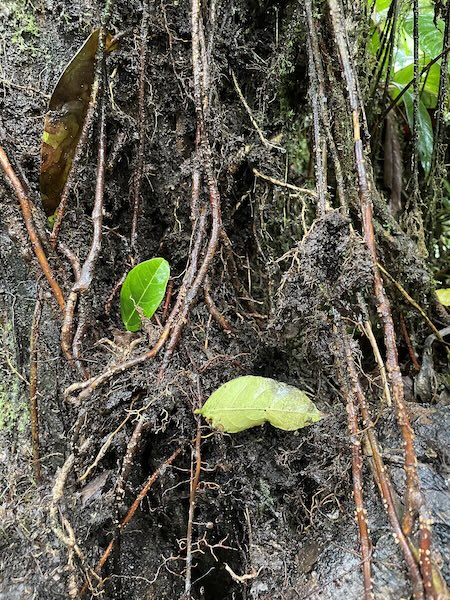
Ground soils can be mapped and categorized based on their location, the rocks they come from, the soil structure, and the nutrients they contain. The same cannot be said for canopy soil, because it is understudied. It’s not clear whether the canopy soils of Santa Fe carry the same nutrients and elements as those in the Amazon or Peru, for example.
Where can you find canopy soil?
Most trees do not accumulate canopy soil. You’re most likely to find this material on big trees in cool and foggy areas, largely in older cloud forests and temperate rainforests. In addition to Santa Fe National Park, canopy soils can be found in Costa Rica, Chile, tropical Africa, Japan, Borneo, New Zealand, the Hoh rainforest in Washington State, and elsewhere.
Several conditions promote the growth of canopy soil. The first is large trees, “because that's where the real estate is,” explains Lucas. “You’ve got to have a big and stable area to allow mosses and epiphytes to accumulate.”
Moisture is also key. Canopy soil tends to develop in older forests that can maintain a wet environment, and often are abundant in places high enough in elevation that clouds provide consistent moisture. The wetness allows plants to thrive and slows down decomposition.
Temperatures need to be warm enough to keep plants growing and accumulating, yet cool enough to slow down decomposition. In hotter rainforests, material decomposes too quickly and moves out of the trees.
What lives in canopy soil?
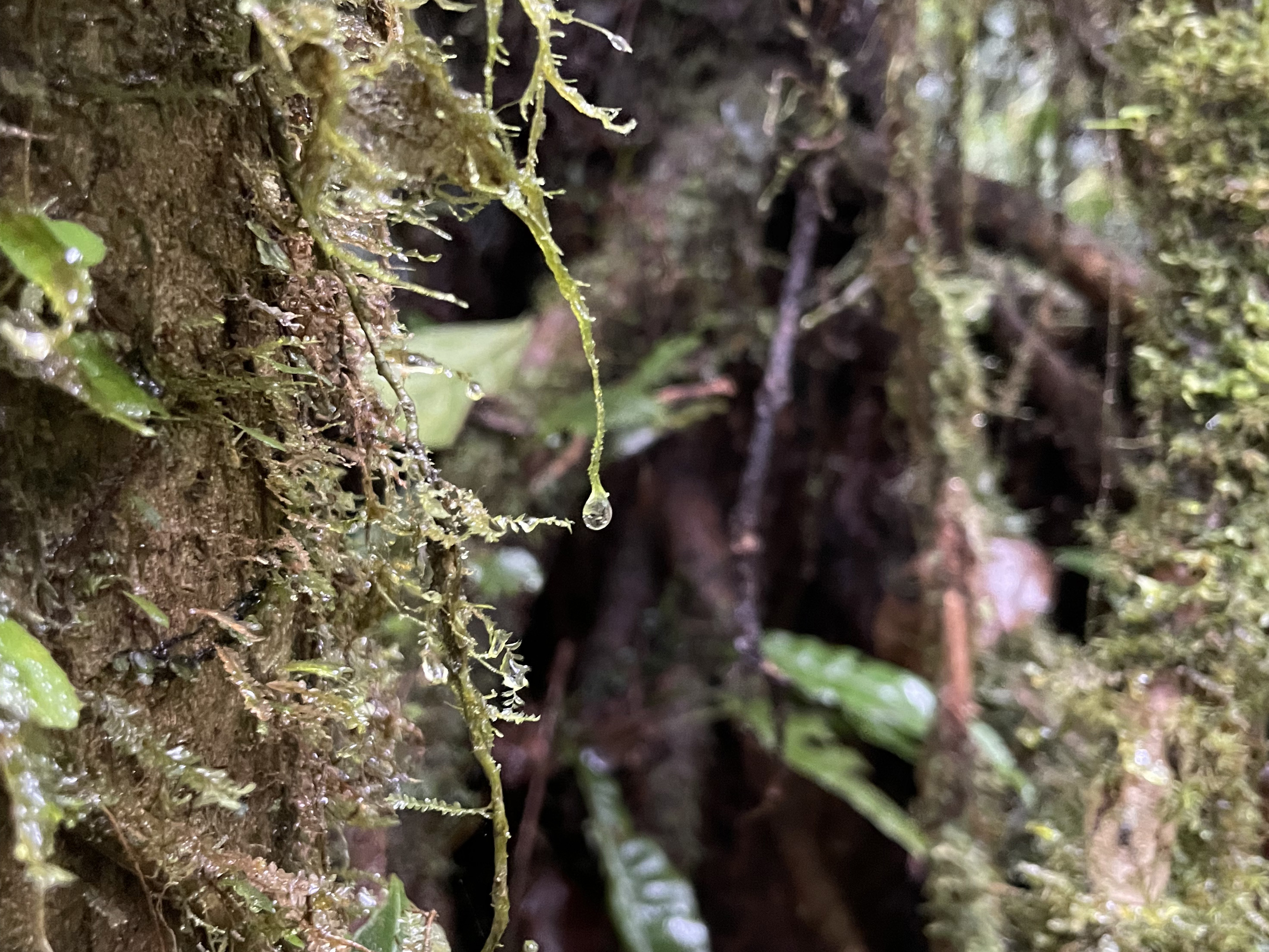
In addition to hosting plants, small animals, and a unique community of insects, microbes live in canopy soil — but scientists don’t really know which ones.
“We know so little about what canopy soil is made up of, or who lives in it,” explains Lucas. “These are really fundamental questions we are looking to address.”
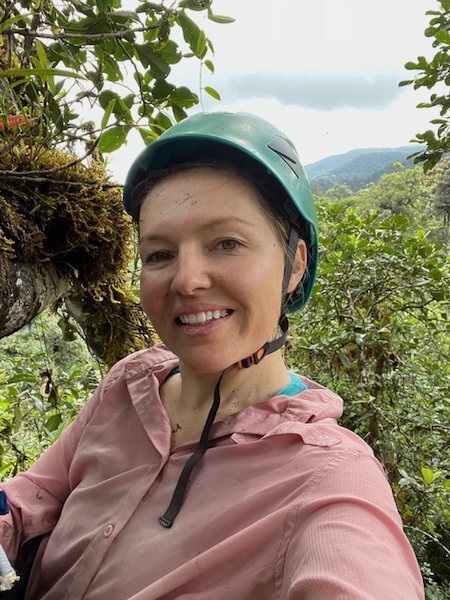
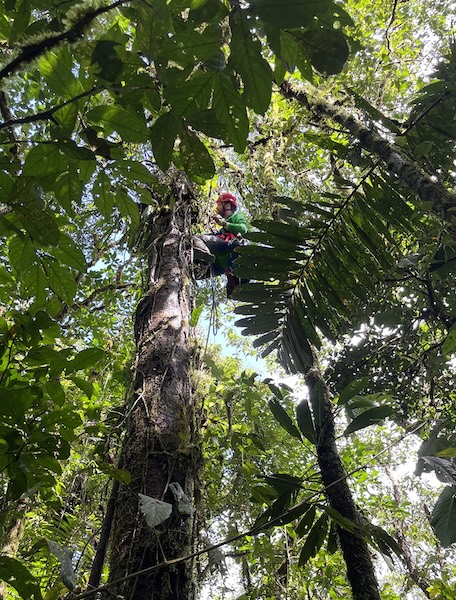
The new project she co-leads has the team climbing up into 24 treetops in Santa Fe National Park, searching for the answers to these questions and more. They will collect soil samples from the ground at the base of the tree and from the canopy — and bring them back to the lab to see which microscopic bacteria and fungi live at each height.
Weather conditions are dramatically different at the different sampling heights. The ground is relatively cool and wet. Going up 20 meters, the soils (and climbers) experience temperatures 3 to 5 degrees Celsius (5.4 to 9 degrees Fahrenheit) hotter. It’s also drier, and conditions are more variable. Because these changes are all expected under climate change, canopy soil provides a model system to study how climate change may impact microbes in the future. “It’s as if the microbes in the tree tops are already living under the stressful conditions of a climate-changed future,” Lucas explains.
The team will study the microbes to see what helps them thrive under those conditions, and better understand which groups of microbes and microbial traits can be expected to thrive under climate change — and which ones might go extinct.
The survival of microbes is probably not most people’s topmost concern when they think about the impacts of climate change, but it’s no small matter.
“Microbes do everything,” explains Lucas. “Microbes are the reason soils function to grow our plants and store carbon. They’re also the ones doing all the decomposing and nutrient recycling. So if you care about food, if you care about the carbon cycle, if you don’t want to walk around in a world filled with trash and dead trees, we need to know how to take care of our microbes, so that they can continue to function.”
Is canopy soil important for carbon storage?
Canopy soils are thought to be very carbon-rich, similar to the peat that stores massive amounts of carbon in boreal regions. But unlike large, flat peatlands, it’s hard to estimate the abundance of canopy soil because it is spread unevenly across tree trunks and branches.
“We have very limited estimates of how much canopy soil is out there and how much carbon might be sitting in these trees,” says Lucas. “So they are completely unaccounted for in most carbon models.”
In the lab, Lucas plans to measure carbon emissions from the canopy soil samples, and see how those emissions change across different climatic conditions. She’s also interested in investigating which microbes might be important for maintaining carbon storage in these soils.
One study in Costa Rica estimated that canopy soil accounts for 0.4 to 4% of soil carbon in the forests where it is found, but this may vary greatly depending on the forest. In the Hoh Rainforest in Washington State, for example, canopy soil can form mats that are several feet thick that may be storing up to 20% of the forest’s soil carbon, according to a different study. The numbers are probably lower in Santa Fe National Park, where the soil canopy doesn’t accumulate so thickly.
Nevertheless, says Lucas, “I do think we are vastly underestimating canopy soil as a carbon pool.”
Is canopy soil good for trees?
Some studies have found that trees sometimes grow roots into the canopy soil that accumulates on their branches and trunks, presumably to absorb water and nutrients.
It is possible that holding the extra weight and having decaying matter on its branches could have drawbacks for the tree, but scientists don’t know yet.
Why do we know so little about canopy soil?
“Because it’s hard to access,” says Lucas. “Canopy soil tends to accumulate in high elevation, dense forests that are less developed, so there aren’t roads driving through them. So first you have to figure out how to get to the trees with canopy soil, and then you have to set up ropes to climb them, which also takes a lot of work.”
With the team rigging 24 trees in Santa Fe with climbing infrastructure, they hope it will soon become easier to answer many of these open questions about canopy soil, and more.
“We already have people coming out of the woodwork and asking, while we're up there, can we take bark and tree cores to look at methane production and consumption up the tree, and we have others interested in plant root traits at different heights,” says Lucas. “This project is very much the entry point for so many more experiments. If I wanted to, I could spend the rest of my career studying canopy soil, and we would never run out of questions to ask.”


