


Adapted from a press release by AGU
Wildfires can benefit forests by clearing old debris, leaving behind fertilizer, and more. For over a century, the United States has poured billions of dollars into fire suppression tactics to keep people, homes and critical environments safe, but suppression can deprive landscapes of necessary burns and increase potential fuel for large fires in the future.
New research to be presented at AGU’s 2025 Annual Meeting in New Orleans has found nearly 38 million hectares of land in the western United States is historically behind on its burning, leaving those lands in a “fire deficit.” This acreage has been updated from 59 million in the abstract to the final number of 38 million.
Winslow Hansen, director of the Western Fire and Forest Resilience Collaborative and scientist at Cary Institute of Ecosystem Studies, will present the findings on December 18.
“Conditions are getting so warm and dry that it’s causing huge amounts of fire compared to the historical record,” said Hansen. “However, we still are dealing with the legacy of 150 years of fire suppression. Together, drying conditions and overly dense fuels portend a challenging and more fiery future.”
To discover which areas were in a fire deficit or a fire surplus, researchers leveraged geospatial data, like pollen records and dirt samples, to determine historical fire return intervals that were then reconstructed by the Landfire program.
Compared to the historical patterns of annual burn area that emerged in the data, 74% of the western U.S. is currently in a fire deficit. To make up that debt, 3.8 million hectares of forest would need to burn each year over a decade. That yearly burn area is three times the amount of forested area that burned in 2020, the current record year for wildfire burn area in the U.S.
That amount of burning is daunting, but Hansen and his team highlight that multiple strategies could be used. Officials must use a combination of prescribed burns, mechanical thinning and even managed wildfire use to erase the deficit.
“There are still lots of wildfires that burn today… that are reducing our fuel loads and revitalizing ecosystems,” said Hansen. “Instead of suppressing those fires and putting them out, we’ve got to let them do good ecological work to help us tackle this challenge when risk is low.”
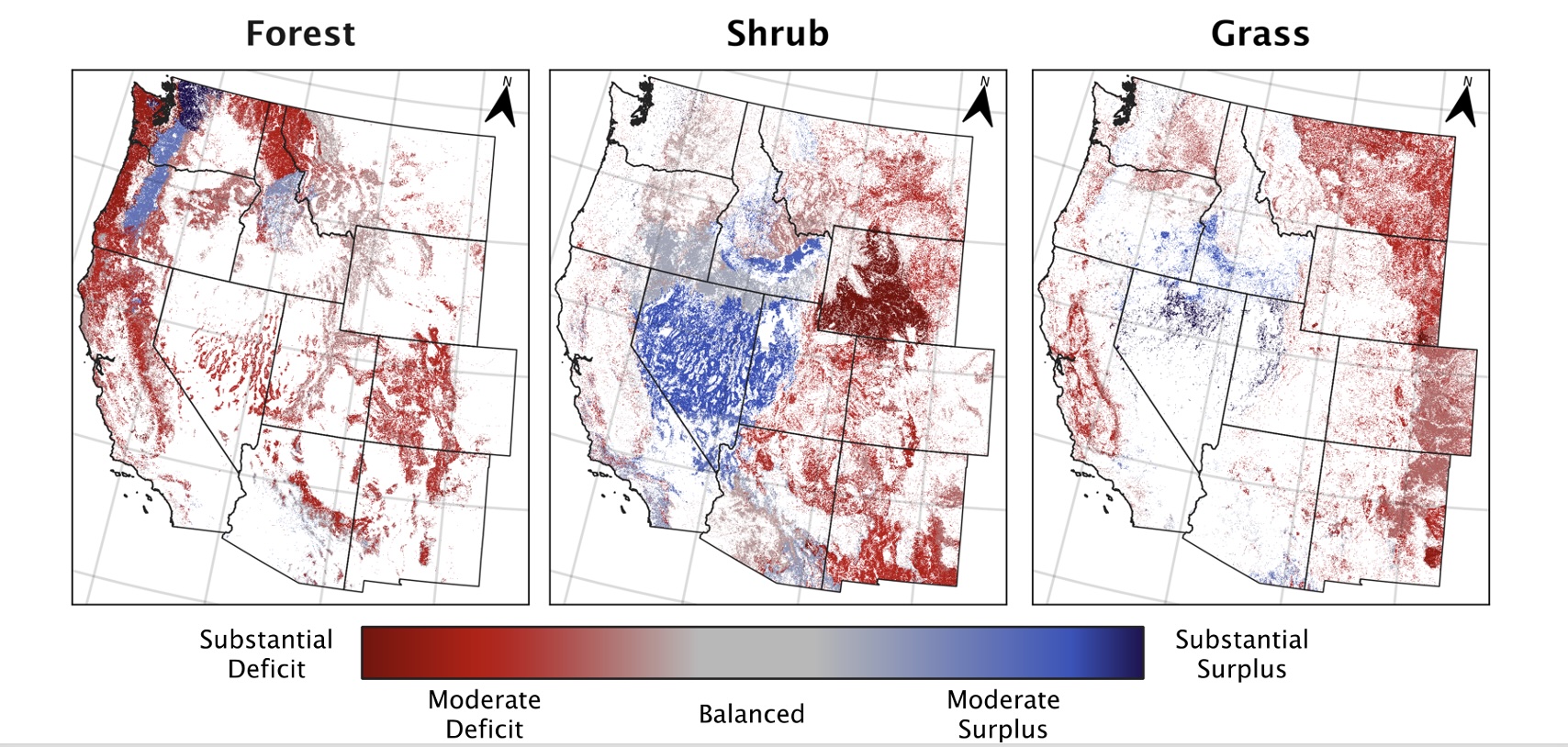
While much of the West may be behind on its annual fires, the southwest is facing the opposite problem. Human-started wildfires have spurred a fire surplus in shrublands and chapparal ecosystems, especially in Southern California.
“You’re getting more fire than you would have historically, which can even threaten resilience,” Hansen said. “These shrubland ecosystems might not be able to regenerate if the fire is too frequent.”
Parts of Cascadia are also in a fire surplus due to climate change increasing extreme temperatures and droughts, both of which help set the stage for blazes.
“I was a little bit surprised to see these signals of climate change-driven surplus already,” said Hansen. “I’d expected that would be something we would see in the next decade or two instead.”
About the presentation:
Thursday, 18 December, 11:45 – 11:55 Central Time, Room 265-266 NOLA Convention Center
Live stream access is open to media. Members of the press and public information officers can request complimentary press registration.


.jpg)