
From Discoveries to Decisions: Science for a Changing World

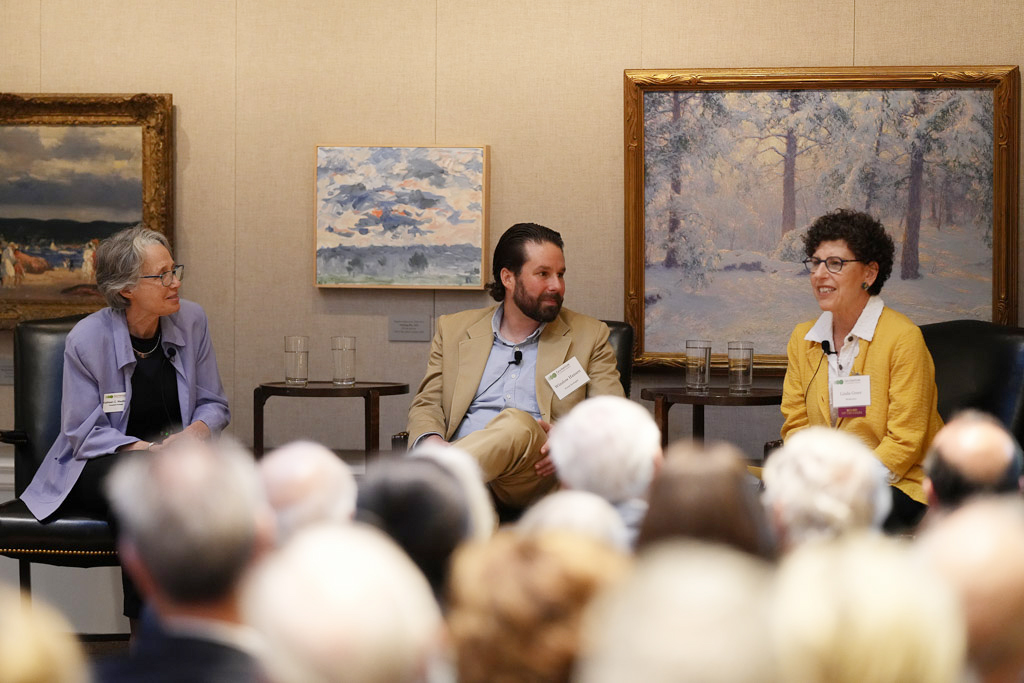
A conversation with Dr. Winslow Hansen and Dr. Kathleen Weathers, guided by Dr. Linda Greer.

Audio of a talk presented at Cocktails & Conversation with Cary Institute

Winslow Hansen discusses how fire has been a natural and essential part of ecosystems for hundreds of millions of years, with many species adapted to and dependent on it. However, a century of fire suppression—combined with the loss of Indigenous burning practices and the impacts of climate change—has led to more severe, destructive wildfires and fewer beneficial ones. Today, the challenge is not just understanding fire’s role, but managing it effectively.

Winslow Hansen explains how he founded The Western Fire and Forest Resilience Collaborative (WFFRC) to address this gap, bringing together scientists and land managers to develop practical, science-based solutions. While the group has made strong scientific progress, it is now focusing on increasing real-world impact by improving collaboration with managers and delivering faster, decision-relevant tools. Emerging technologies, including satellite monitoring and AI, offer new opportunities to identify and manage beneficial fires. The goal is to help communities coexist more safely with fire while restoring ecological balance.

Kathie Weathers talks about how scientists traditionally have linked harmful algal blooms to nutrient-rich conditions, particularly excess nitrogen and phosphorus, and warmer temperatures in lakes. However, recent research has revealed a surprising pattern: harmful blooms are also occurring in nutrient-poor, or oligotrophic, lakes where these conditions are not present. Scientists discovered that certain cyanobacteria can access phosphorus stored in lake sediments and fix nitrogen directly from the atmosphere, allowing them to thrive independently of external nutrient inputs. This finding challenges long-standing assumptions about what drives algal blooms.

The Global Lake Ecological Observatory Network (GLEON) seeks to to better understand these dynamics. Using sensor-equipped buoys and community-based observations, scientists can track how lakes “breathe”—measuring photosynthesis and respiration in real time across diverse environments. This collaborative, global approach has revealed that cyanobacterial blooms in low-nutrient lakes are widespread, prompting a shift in scientific understanding. Ultimately, this research highlights the importance of integrating technology, local knowledge, and international collaboration to better predict and manage freshwater ecosystem changes.

Transcript

Joshua Ginsberg  0:00  
Shoot, and it is a real pleasure to introduce you to our inaugural, inaugural by which I suggest this is not the last, but the first of what we hope is a series of cocktails and conversations. We're going to discuss science, from discoveries to decisions. Science for a changing world, and we can interpret changing in so many different ways these days, but we'll leave it vague and let you imagine it's great to see a lot of new faces in the crowd, a much more diverse demography than we've had it at past events in the city. And I'll just give a little bit of a nod to my development staff, who said to me last year after our most successful spring lunch, we need to try something different. And the reason was several fold. We ask you for feedback. So this is the first time we're doing this. I would love to get feedback from any and all of you. President at Cary institute.org, that's C, A R Y. Laurie will thank me for that. C, A R Y, Institute, one word.org, and some of the feedback we got went as follows, I'd love to come, but, you know, I've got a real job, and I can't take two hours off in the middle of the day. Or, you know, the best part of your spring lunch is the cocktails and the wine beforehand, where I can catch up with friends and talk, or I really love that you put science in your lunch. But could it be more than 15 minutes? And so if you take all those critiques and put them together, what you get is a evening Cocktail Hour, which goes for an hour and a half so that people really can spend time with their friends, followed by 40 minutes of scintillating discussion by brilliant scientists. And so that's what we're going to be doing tonight. For those of you who are new and have not visited the Carey Institute, we're an Independent Research Institute based in Millbrook, New York, 100 miles north of the city. We're in our 44th year, and we do large scale ecological research that we hope will help answer important social questions. We are driven by questions, not by answers necessarily. But there is a strong commitment from our founder, Gene likens, who accidentally discovered acid rain and then spent the next 20 years trying to remediate it. There is a strong commitment to applying our work or helping others do so. All right, I need to thank people, and this is why I have cards, because inevitably, if you start naming names, if you don't have the cards, you'll miss somebody. So I first want to thank our co chairs, our trustee, Beth Comstock, and Chris, her husband, Chris travers, Jane Banta Fisher and rich Fisher, who are here with their mother, who is a long term supporter and a son. So we have three generations of Banta fishers, thank you. Nicola and Peter Gray, who unfortunately couldn't make it tonight. Katherine Heinz, who is a friend and long term supporter fan. Roger Liddell, my neighbors in Sharon, Connecticut, good friends and supporters. Robbie Anne Macken, trustee and Eric Roberts. Roberts, Trustee Emeritus. Thank you guys for coming and bringing your friends. Tim and Coco Quinlan, the three Karen's group, again, quinlans are multi generational supporters. Three Karen's group who Lee Strickler and Mark logley, who founded the three Karens, are old friends, and they do remarkable work in climate and mentoring of young scientists, and really are a tremendous supporter of so many wonderful things. And finally, Steve Tilley, who is been part of our family for years, and I'm so glad to see you here, Steve. I also want to thank the host committee, and if I did that, I would run over my four minutes. So I'm going to thank them generally. This these events take a real community, and so all of you who have been engaged and helped bring new people, and there are so many new people, I'm really grateful for that, trustees, I won't make you stand up, but wave your hands so people know who you are. Come on, Hugo, put it up. There we go. Trustees are the most remarkable people. They are immensely talented, creative, insightful people who volunteer their expertise for our institution, right? They don't get paid anything. In fact, we often ask them to pay for the privilege of being on the board of Carey Institute, so I am incredibly grateful that you also managed to come to our events and also our scientists, two of whom are on stage. You can wave your hands, but they'll get to know you and in the crowd as well. Please Flag. Flag for people who you are. There we go. So thank you for that. All right, let me just do the briefest introductions. Kathy weathers is a distinguished senior scientist at Cary Institute. My notes say she's a global leader in Freshwater Science. I'd like to say she's a global leader in ecology and Ecosystem Science, former

Joshua Ginsberg  4:55  
president of the Ecological Society, the founder of the co founder of the global Lake. Ecological Observatory Network, fellow of the Ecological Society, the American Association for the Advancement of Science, a recipient of the National Science Foundation directors award. And I will stop there, because it gets really embarrassing for Kathy. But needless to say, Kathy has done many, many interesting things. You will hear about some of them, and your second speaker for tonight is Winslow. Hanson. Winslow recently joined Carey four years ago now almost five. Yeah, right. We're coming up for your second review. Winslow is also on his way to to being distinguished. He is the founder of the globe, of the Western fire and forest resilience collaborative, of which you will hear more about. He was elected, along with Tara Stewart Merrill, another one of our early career scientists, as an early career fellow of the Ecological Society. I'll put it in context. There are 9000 members of the Ecological Society. Last year, they elected 10 early career fellows, Winslow and Tara two carry scientists were two out of the 10. I think that's called punching above your weight. And we are blessed in so many ways to have Linda Greer as a trustee. Linda spent many years at NRDC as a public health specialist. She has done all the things that a PhD scientist at NRDC would do. She's testified to Congress. She's worked with scientists to help inform policy. She's advised National Academy of Science and EPA advisory board, and just taught at Vermont Law School. Most importantly, she took a sabbatical and went and ran the University of Michigan's biological field station. So not only does she know how to move policy needles, she knows how to manage a field based science organization, for which I am deeply grateful. So Linda also is passionate about communicating science, so I am doubly grateful that she will be your moderator this evening. Take it away, Linda.

Linda Greer  6:58  
Okay, thank you very much. I think I'm Mike. So can you all hear me? Okay, all right, great. So let's see. We're going to dive in very quickly and just to recap, Carrie hires tippity top scientists. Their credentials are quite renowned. When Frances Beinecke asked me if I'd think about sitting on the board, and she said, Well, it's this place called the Carey Institute. I said, Oh, I know the Carey Institute. There was no, no question there. And the organization works, what's interesting, you know, locally, nationally and globally. So they really span the full geography, and they work very broadly on a lot of different topics, climate change, water problems, environmentally linked diseases. A lot of other organizations are very much more specialized, and Cary is less specialized, all to its To its credit tonight, what we're going to talk about, which is actually a favorite topic of mine, is how to effectively take scientific discovery and research and use it to influence and help environmental decision making in the real world. And this is not as easy as it sounds, actually, and it's also very unusual, but we have two scientists who are doing this themselves, and so we will be hearing straight from the horse's mouth, so to speak, how how they are doing it, and what challenges they face in doing it. You know, just to recap, scientists, for the most part, you know, they're very involved in discovery. They love the puzzles. They work, oftentimes by themselves, or at least just with a group of very similarly trained scientists, and then decision makers. You know, they're often flying blind. You know, they know they've got a lot of complicated decisions. They may not even be aware of some of the scientific knowledge and information that would help them, but they're just not necessarily plugged into a scientific research establishment. And so two different wavelengths and ships sort of passing in the night is very typical experience. And what we see at Cary, in addition to the very excellent science that is done by many scientists at the organization, are these very innovative, creative efforts to plug that information into environmental decision making and sort of bridge that gap between discovery and decision making. So we're going to have four areas of discussion. We're going to get to know our two scientists a little bit. We're going to learn a few scientific facts from them that I hope are kind of like, oh, wow, I never thought of that before. We're then going to talk about the initiatives that they are personally doing that bridge this gap between their scientific research and decision making, and then we're going to end it like, why are they at Cary? And what's the special sauce here at. Carry we're going to talk for about 30 minutes. My stretch goal is that at the end of 30 minutes, you wished we were talking for 30 more. Now that's a stretch goal on a cocktail party, I will grant you, but No guts, no glory. At the end of the evening, you can tell me whether I've achieved my stretch goal, and we'll have time for Q and A at the end. Those of you that want to get out because you need to get home, please don't be embarrassed to do that. All right, so we're going to dive in. We're going to start with Winslow. Winslow is a Fire Fire Ecologist. He works with fire specifically, he works on North American western forests, and I think there is no need for me to be labor. The important problem we have with catastrophic fires out west, we see how fast they have accumulated and been growing. And we, even ourselves, experienced smoke from those fires here on the East Coast, you know, so many miles away and so Winslow, tell us how you got into this line of work, of fire ecology.

Winslow Hansen  11:08  
Yeah, thanks. Before I answer that, just really quickly, I wanted to say thanks to all of you for the being here today. I know it's hard on a Wednesday night to make time for these things. We're very grateful. And also wanted to say thank you to you, Linda. Linda gave a talk at Carrie a couple months ago when she first joined the board, and I was completely enthralled, and so I'm pinching myself now being on the stage with you here today. So so fire has been a through line of my life. I grew up in western Montana, a town called Bozeman. Many of you are probably familiar with it. When we moved there, when I was a little kid, it was a cow town, right? And, of course, no longer that's the case, and the forest there burned, right? So we lived on a little property, not, you know, big mansion, but a little property next to the National Forest, and in 2001 a wildfire burned up right to our property. We were evacuated. I remember the firefighters encasing our home with with foam. They protected it. We're very grateful for them to do that. And so it was really scary, right? Like we experienced the destructive, scary nature of fire. But then the next year, we would go out into the woods and walk around and explore and and you could see the revitalizing aspects of it as well. So there were little seedlings popping their heads out of that that burned soil. There were beautiful morel mushrooms popping out that we'd harvest and cook up delicious. And I always had the research bug, but, but I didn't come back to fire for a while. So I actually moved up to Fairbanks, Alaska. It's literally the end of the road, right far away from my parents as I could get without getting on an airplane and and I was starting a master's degree there and really committed to doing research, but had absolutely no idea what I wanted to study. Just so happened that my office was in the same space as a boundary organization that focused on bringing fire scientists and managers together to support managers. And it was, it was this light bulb moment, because the the program officer was like, you don't know what you don't know what you want to study. Here's a list of 20 priority questions that fire managers have for fire scientists. Pick two of them, and there's your master's degree. And that's literally what it was. And I hit the ground running and haven't stopped. So my light bulb moments of discovery and being able to have impact as a scientist came on at the same time, right? They were never separate instances, and I've been following that strand ever since,

Linda Greer  13:46  
yeah, that is so great. And Kathy, you've spent the last couple of decades plus studying lakes, and I just, I just love your origin story, so fill us in. Yeah.

Kathie Weathers  13:58  
Well, thank you, Linda for being here, and I, like Winslow, appreciate that all of you are here as well, and that you get to moderate this conversation. So I spent the last couple of decades, actually, from the beginning of my scientific career, working on air pollution and forests, working on how clouds and fog and develop impacted areas and what forests how forests respond to that in the Catskill Mountains and the Appalachians focused mainly on the systems of atmosphere and the systems of forests and their response. And I also continued some of that research. I also have a passion for fog and the atmospheric influence of fog and coastal areas around the world. I continue that research as well, but I was trained as a system scientist and not as a lake scientist. I was, I was trained by a very famous Lake scientist all. Also known as a limnologist, who was Gene likens, and again, he taught me everything about about Lake science, its history, but I wasn't a lake scientist. So how did I become a lake scientist? Well, it was through this crazy sabbatical that I ended up doing. I was invited by the lake Sunapee Protective Association. It's a it's an over 100 year old association that has in its mission from 1898 that science should be should underpin their decisions and their outreach and their education. So since 1898 they'd had this, that's their mission. Yet, even today, we don't really know how that works. How is it that science can underpin your outreach, your education, the decisions that you make? So with this forward looking board and and, you know, with with some of my ideas, we decided I would do a sabbatical, crazy, out of the box sabbatical. No one does a sabbatical to do this kind of thing, from their their research, and I would join with them and explore how this might happen. So it was, it's all about translation. It was all about looking around the world and understanding what, what was happening to lakes, and bringing it back to this lake association so that they could make decisions based on on sound science. I didn't have a question, a research question. So truth in advertising. I have known Lake Sunapee since I was zero years old, thanks to my grandmother, and I've known the mountains around Lake Sunapee as well. And I spent ages, hours exploring, wondering about the natural world in the lake. It was a beautiful, Crystal, clear, clean Lake, fresh water lake in the mountains. And actually, that's when my passion for puzzles, ecological puzzles, came about. Yet I didn't know anything about becoming a scientist. I didn't know that it was even a profession until after getting an undergraduate degree in the humanities and realizing that those puzzles that I was trying to solve, those questions I was I had, about how the natural world worked, might be possible to do as a profession, I ran into someone studying in the mountains. They were doing research project in the mountains. Oh my gosh. I grew up in a family of lawyers and finance people and business people. So being a scientist wasn't, wasn't part of the deal. And that's a much longer story about how I came back to do, do the science I'm doing. So I entered in to this, this, this deal with the lake Association, and didn't have a scientific question about lakes, and lots of questions about the atmosphere, but not about lakes. And within a week of arriving there, in came community members with a little jam jar filled with algae filled with green scum, which they had scooped off the surface of the lake. And this is a beautiful blue lake. It's not a Green Lake, it's a blue lake. And they came in and said, What's this? And it turns out that is a major ecological puzzle, which you'll hear soon, that the whole world is looking at, why are cyanobacteria blooming? It's a cyanobacteria or blue green blue. Green Algae are harmful algal blooms, which we'll talk about in just a minute. Why are they blooming in this lake? So it started an adventure creating knowledge with community members, and we'll talk about science in just a minute.

Linda Greer  18:35  
I love the serendipity in both of your stories that you kind of bumped into the right question in the right person at the right time, and you'll all be missed to hear that I stumbled into the world of environmental advocacy as a scientist because my college roommate was dating a guy who worked at the Environmental Defense Fund briefly, by the way, not even for that long. So you know, that's the way these things can roll. Okay, so I think we're ready to dive a little bit into the science and Winslow, I have really learned a lot from our preparation together. That has been very eye opening to me about about fire. And, you know, growing up as a girl scout, I was all about putting out the fire and preventing fire, that was like a major thing. And you know, Smokey the Bear was out there telling us that only we could prevent forest fires. But what has come to be is that all that prevention really created many of the problems that we have today. And so could you fill us in a little bit on some of the interesting principles of fire ecology and some of the scientific work that you've been doing. Yeah, absolutely.

Winslow Hansen  19:49  
And, and if you want to hear more about any of this, we're going to have a conversation with Stephen pine, a very famous environmental historian who studies the history of fire, next month. So. I definitely feel free to participate in that as well. It's really interesting. So we spent 150 years thinking that we could and should put out wildfires. And the reality is, is, it's, it's like rolling a boulder up a hill, right? Ever since plants moved on to land roughly 450 million years ago, fires have burned in our landscapes. And tree species and other wildlife species are evolutionarily adapted to fire. In fact, they need fire, and so when we started suppressing fires 150 years ago, by the way, we also extirpated cultural burning by indigenous communities who understood and embraced fire, we created a real problem with for ourselves that we're dealing with today. And then you add on top of that, climate change, many of these landscapes, especially out west, with climate change, are getting a lot warmer and drier, and what that's leading to is hot, dry conditions. If you've ever had a campfire, you know that you want your fuel to be dry and a lot of fuel in our forests. And so what that means is today, we have way too much destructive, fast, catastrophic fire, and not enough ecologically beneficial fire that's playing the role that it always has, reducing fuel loads, revitalizing ecosystems. And the thing is, is this is not just something that scientists know. Managers get it, that you go talk to folks in the Forest Service, you talk to state DNR, they understand the importance. The challenge is, is that we don't have the science and decision support tools to really leverage beneficial wildfire and to use it to create an environment where communities can live more safely and sustainably in harmony with the fire regimes.

Linda Greer  21:52  
And even the definition of beneficial fire is still up for grabs, right? What's right really looks like

Winslow Hansen  21:58  
great foreshadow the next question, absolutely right? That's a term that has a lot of values attached to it. And so a lot of the work that we're doing, which I'll talk about in a little bit, is focused on first defining what it is ecologically, what role it plays socially, and then how do we measure it? How do we measure it in the field, and how do we measure it from satellites, so that we can empower managers to actually use this information to accomplish the pretty monumental tasks that they're faced with?

Linda Greer  22:32  
Okay, sorry for jumping the gun a little bit, but that is a good foreshadowing. We can all agree. So Kathy, you have worked across a large number of lakes and a large number of Lake problems, but let's talk more about Blue Green Algae blooms. I thought that would be a good one for us to focus on tonight. Many people have heard about the problem of blue green algae blooms, and you know, they can be very damaging and very disruptive for water for water supply sources, and also for the ecology in those lakes. And so again, what you had to teach me was very counterintuitive to what I learned in science school. And so fill us in on those blooms.

Kathie Weathers  23:13  
Yeah, well, so this actually is the bloom that was discovered in Lake Sunapee, New Hampshire, in this blue water lake and the bloom and light blooms that we've been studying for the last last 20 years. So backing up a little bit again, cyanobacteria blooms are harmful. Algal blooms are blue green algae blooms, they're photosynthesizing plants. We have a lot to thank them for in terms of producing oxygen and fixing carbon. They're normal. They've been around for 3 billion years. What's not normal is when they bloom, and often when they bloom, they're toxic as well. So as Linda points out, it's a huge, huge problem. So this one was a huge puzzle, and the reason is, is that everything we know about blooms are from green skyny lakes. You know. We know. We know that nutrients and excess of nutrients, nitrogen and phosphorus, the same things that you put on your garden to make them grow, result in cyanobacterial blooms in Lake Erie, in lakes around the world, and you've probably heard about them, you've probably heard about them at some of your favorite beaches in recent years. So we know that they have high nitrogen. We know that they have high phosphorus. We know that blooms like it hot. So as the temperatures increase in lakes, the blooms are also present. So the question is, what's happening in this lake that has no nitrogen, no phosphorus? In the lake, its temperature hasn't been rising as quickly as other lakes around the world. And so the question is, ecological. Question is, what is happening? And through a lot of research, we have realized that these cyanobacteria that are in these oligotrophic lakes here and actually around the world, are able to access phosphorus that's locked in the bottom of the lake, and float themselves up to the top of the lake and access the nitrogen that's in the atmosphere. 78% of the nitrogen is in the atmosphere, and you can't access it unless you have the mechanisms. And so the little floating packets of nutrient rich cyanobacteria, so they're there, they're making a living on their own. And so we've had to kind of revisit all kinds of ways in which we understand that these blooms are driven, and I'll go into a little bit more about how we've done that and in a little bit. But this is an example of some of the cyanobacteria blooms around the world. It is they're impenetrable and problematic. And again, why are they happening in blue lakes? And what do we need to know in order to predict how these incredible resources, I mean, fresh water, is life. We don't live without fresh water, and it's a resource that's that's changing fast. We need to understand these freshwater lakes for which we have no science, because why study a lake if there's no problem, we have no science. We need to understand these, these, these blooms.

Linda Greer  26:28  
Yeah, this, to me, is like a bad sci fi movie. I mean, here are these microorganisms. They don't even have a nucleus. Okay, how are they even figuring this out? They're down at the bottom. They've lived there for ages, and they're going to, like, change the whole nature of their environment so that they can bloom. It's crazy to me. And I, you know, grew up thinking, oh well, they just find a very nutrient rich Lake, and they take off. So there

Kathie Weathers  26:53  
you go. And again, it's the blooms, you know. So they've been around forever. They've been doing

Linda Greer  26:57  
this forever, for millennia. Yeah, really, sci fi. Okay. Now let us turn to the way that you two guys are working outside of the traditional scientific sphere, and your collaboration with the world outside of science per se. Because I think this is, well, this is for one the particular focus of tonight, but is also such a unique way that you work, and it's so creative, it's so innovative, it's so messy and difficult. And I think it really encapsulates why a lot of scientists don't do this kind of thing, because it does take a certain type of person and a certain level of interest. So Winslow, tell us about wifrik, reminding people what that even stands for. Sort of start with how it started, you know, its origin story, and then take us through some of the decision makers that you work with and what some of the issues

Winslow Hansen  27:55  
are sure. So whifrick. It's the colloquial name, our loving name for it, yes, the Western fire and forest resilience collaborative, and it's a it's a group of researchers and boundary spanners that are working together to try to tackle the most challenging, urgent Questions related to fire science. Is that better? Sorry, so we're trying to tackle the most urgent, complex questions related to fire science, but we're also working hand in glove with managers across the West to take that science that we produce and the science that others in the community are producing and to develop durable, practical strategies that help them do their job. It's also the origin of all the gray hairs I have right now and many to come in the future.

Winslow Hansen  28:51  
And what's interesting, you know, like, I think of woofer kind of like a startup, right? And no startup comes out of thin air. So the origin story is kind of worth a tangent, right? So for some reason, Josh let me out of the office to go up to Alaska in the summer of 2022 and I was starting to do field work up there, starting to develop my program. I brought my post doc and her husband, and we're spending long days out in the field counting seedlings. It's not very sexy work, right? Like hiking in the woods and counting seedlings and digging holes, and I come back from a really long day, and there's an email in my inbox from a program officer at the Gordon and Betty Moore Foundation who I had gotten to know lives in the Bay Area. And you know, she was concerned about fire and and the challenges that the community was facing, and we ended up just having this kind of back and forth conversation through email over the course of a couple months, super blue sky thinking just as thought partners, right? And the scale and scope of what we were talking about was so grand that I could never have anticipated there would ever be funding to do this. So. There was never the pressure that many people who who engage in fundraising experience where, you know, like, there's always something on the line. There was nothing on the line here, turns out, she was developing a special initiative to take to the Moore Foundation Board of Trustees for a five to 10 year, 100 plus million dollar program focused around this, of which wifreck is one of the Keystone projects. And so within six months, we actually had to do it, and here we are three four years later, we've been in operations for three years, and we built a community that's up to about 60 scientists and boundary spanners. You can see kind of progression there of how we've grown over time. And about last year, this time, I was talking with my deputy director, and we were really thinking, you know, what have we accomplished? Where are we going? Where are we falling flat? And we really felt like we were, you know, cooking with gas when it comes to the science. So not to fall into the trap of the traditional academic metrics, but last year, woofwork scientists submitted more than 80 papers. Right? We were hitting the classic metrics just fine, but we felt like we weren't really living into our aspirations to have impact as much as we wanted to. And so we've spent the last year really trying to develop and refresh and rethink our strategy about how we engage with managers, and we actually just hired three new positions, so we have regional liaisons now in key states, starting with Colorado. That person officially signed the letter yesterday, so that's great. We're going to hire somebody in the Northern Rockies, and these people are going to be our eyes and ears on the ground in the meetings with managers, right? As much as I try to be in every meeting, coffee shop, brewery in the West, it's big country, I can't be in all of them, right? And so these are going to be the people who are building relationships and hearing what manager needs are. And then we're going to back them up with a technical staff that can answer questions on decision relevant timelines. So not the three years that it takes to do the highest impact blue sky science, but the practical science that you can accomplish in three weeks, six months to answer these questions that managers are really pressed with. So you know, wifreck, I often have a hard time explaining what it actually is. It's this broad umbrella. It's convoluted. We do lots of stuff. And so I found that actually it can be a little more helpful to provide some examples of products that we're producing. And so one product that a couple of our CO PIs came together to produce was actually quantifying that good wildfire that I talked about previously, right? So we use satellites to measure where fire is burning in ecologically beneficial ways, reducing fuels, revitalizing ecosystems, increasing resilience, and where is it burning destructively. And besides the fact that it's cool to measure stuff from satellite, and you know, it's kind of techy and fun, it actually led to some really fascinating insights. So what they found is that over a decade long period from 2010 to 2020 even though the government still suppressed roughly 98% of wildfires out West during that time, good wildfire still treated two fold more area of our forest than we could have accomplished with prescribed burning during that time. So what does that mean? It means there's substantial unrealized potential to use beneficial wildfire where we can and so what we're doing now is developing decision support tools that leverage AI partnerships with organizations like google.org, and new satellite constellations that are coming online to try to provide managers with the tools that will let them make decisions and then convey the reasons for making those decisions to the public about where they let beneficial fires burn when they can do so safely and when they still use suppression. And we really feel like we're on a precipice of change where these technologies are going to unlock fundamentally different approaches to managing fires out west. We're really optimistic and hopeful.

Linda Greer  34:15  
You know, one of the things I really like about this work is it's such a two way street, so you are providing scientific information to managers who are making tough decisions. The managers are giving you their questions that need to be answered and that need research. So it's not just like I'm a PhD scientist. Read this paper and let me know if you've got any questions. That's not it. What is what you're doing here, and I know what Kathy is going to talk about in a minute is this much more dynamic community of practice. Let's call it that has scientists in it, has decision makers in it. And the you know, the special sauce is that that that cross collaboration outside of the scientific world. And so. So I really think it's an important way for us to understand how effectively bridging the gap, what does that actually look like? That's the kind of thing that it looks like. And Kathy, I am now going to turn to you to give us an even more long term and inspiring example for this. And you know, one thing interesting to me about you is, you know, you've had this incredibly distinguished scientific career by all the standards of publications and awards and recognition, etc, etc, and yet, what you your passion and what you have done is to found and mature this amazing initiative called Glion. So tell us about Glion and tell us about its special sauce.

Kathie Weathers  35:49  
Yes, and what has been so fun about this conversation, a couple of them that we've had, is Winslow is doing what I dreamed about as a grassroots project. So it's kind of the opposite end and and the technology connection is super important here, not as important as the people connection, but but super important. So while I was on sabbatical trying to figure out why these cyanobacteria were blooming, I got a call to do a site review of one of the most famous Lake research sites in the world in Wisconsin and and so I said, Yes. And while I was there, one of the principal investigators pointed to a buoy on a lake, and looking like this, has all kinds of sensors hanging down to the bottom of Lake. And he said, This is the future. He said this is how we're going to know more than just about one lake in Wisconsin and one in New Hampshire. He said these buoys are going to are going to let us understand how lakes breathe around the world. And we've got this thing called Glion, the global Lake Ecological Observatory Network, and it's about buoys around the world and them communicating real time to each other. You know, this, this is the future of understanding Lake science. So I went back to the board at the lake Sunapee Protective Association. I said, we've got to do this. We need to have a buoy, you know, it'll be a magnet. It'll bring in researchers. We can have Lake pals around the world. And much to my surprise, they said, hey, that's great. Get this guy to come out and talk to us about Glion. So I got him to come out talk about Glion, and he spun a little bit. And turns out it's four guys, a couple of buoys, one in Taiwan, one in Wisconsin, one in Israel, and a logo, and so, and a logo is it lives. So, you know, I was crestfallen, and, and so I thought, well, you know, this lake association is not gonna, not gonna buy in here. And they said, huh, oh. And he also said, and, but you can come to an organizational meeting in Australia. We're going around the world, lakes around the world, and Lake Association said, Hey, we're in, we're in. We will with you, find the funding for it, and you'll be our scientist and go to that meeting in Australia. So I did. There were probably about 10 people in two lakes there.

Kathie Weathers  38:21  
We talked about stuff. You know, how do you how do you make buoys? Well, long, long story short, it was the beginning of what has been a remarkable experiment. And not only having buoys, that's high frequency data. Watching lakes breathe daily is super important, and the Cyber Infrastructure has never come about. There is no way to share data around the world as much as people would like to do it. So that's a challenge for some of you computer scientists. So it became less about stuff and more about connecting to people who are taking low frequency samples, the community scientists, people with eyes on the water, who have knowledge. And so we started building this, this community. And I wanted to give you a couple of highlights, actually, that have come out science relevant to Lake Sunapee using these buoys. So these buoys are super important, but this is one of the first studies that ever looked at a suite of lakes. And what you're seeing are lakes breathing, photosynthesis, respiration, the kinds of things that cyanobacteria and other phytoplankton do. And you can see the difference between Lake Sunapee This is great for the lake Sunapee community as well, one end of the continuum, clean water, clear water, drinkable water, and the other end of the continuum, Lake Tai hu in China, so we can begin to see how they breathe. We can't connect it to who's doing that, what phytoplankton, unless we have the local the local data collection. So that's one perspective. There are lots of other perspectives that we've gained. How lakes respond to Hurricane Irene. For example, years ago, we had buoys all up and down the northeast, including the Ashokan reservoir, the water supply for New York City, and learned that some lakes respond very slowly once there's a disturbance, like a Shokan reservoir happens to be one of those. It's just Location, location, location, it gets all kinds of sediment. So some lakes respond very fast. And the most important thing, relative to Sunapee that's come out of this global network of people is this understanding of what's happening in oligotrophic lakes. It's not just Sunapee. Five continents have oligotrophic lakes that also have cyanobacterial blooms, and so now we're putting forward very recently that we need to change up our paradigm for what drives these blooms, and we need to know a lot about the biology. So that's super important. And we've had what, 500 publications by now. There are 1000 members, and a third of them are early careers. And so what we realized early on from a lot of feedback, is we are three networks. We're a network of lakes, we're a network of data, but the most important is we're a network of people. And so we realize that something that probably business people have realized for a very long time, you have to pay attention to the processes that you put in place to allow discovery to happen, to be inclusive, and so we were doing things really differently. We've been a global model about how we do science. We encourage and support early career leadership. So those of us who have been around for a while lead from within global, global leadership of early career folks. We do on conferences, we go to conferences, we go to places around the world. We go to lakes, and we get immersed in their culture. We meet with their managers, with their lake associations around the world. We find out what the problems are, and then we roll up our sleeves and and do science and keep keep doing science. So we've really created new models for how it is that you do science, how it is that discovery will happen and doing global, global science. So it's about people network, and that includes, again, community associations. Turns out, there are community associations around the world. Around the world, they're New Zealand, they're the Irish community. There are all kinds of community members who can create knowledge with scientists, often with a buoy, but not always with a buoy.

Linda Greer  42:25  
So, you know, it's very interesting that origin stories couldn't be more different. You know, here's Winslow's story, where prestigious foundation puts this thing together. It's very top down. It all comes together. And then here's Kathy's story. It's like, literally, you know, four guys in two buoys. And, you know, Lake Sunapee, you know, is running with the big dogs there, you know, with these very famous lakes. So, but I think what you're both saying is the secret sauce is the people and the trust and the sincere interest in what the non scientific questions are to kind of keep the ball, the ball rolling around. I could talk about that all night, but we can't do that, because I want to turn before our time is up. To why Carrie, you know, Cathy, you've spent your entire career at Cary. How is that even possible, and how, what was the special sauce that has kept you there. And Winslow, what attracted you to Carrie and, you know, tell us just a little bit about that. Whichever, whoever first. Why don't you go first?

Kathie Weathers  43:31  
Yeah, well, I know, I think it's the support writ large and the invitation to take risks. You know, a lot of my career was based on serendipity, a gut call. You know, I took some chances where I didn't know if I'd be churning out scientific papers, which is what counts in our academic world. So the opportunity, the privilege, to take chances. There were no models at the time. You know, success was pretty clearly defined. And I think the other thing is that we're not under the university umbrella, which has lots of advantages, but it has some disadvantages as well, and this global network is a good example. I've been able to create fellowship programs and mentor hundreds, actually, of early career folks from around the world at a university. I wouldn't be able to do that so easily. I would need to be focused on the university mission, having students that are focused on the on the on the university mission as well. And so it's been a really unique privilege, as well as, as you know, becoming a leader in this, this grassroots network, spending the time traveling around the world, again, being able to mentor and to be there, be culturally and logistically constrained in any university or even a mission agency, I think, and with. Up, yeah.

Winslow Hansen  45:02  
You know, I'm a long way from home. Carrie is far from the place that I consider where I always thought I would end up, right? And, of course, my parents certainly wish I was closer. We're glad you're here. Thank you. But I think that really speaks to the gravity of Carrie. So Kathy was a little humble and and one of the main reasons that I think Carrie is such a special place is because there are many pathways to success at Carrie. If you're hungry, if you're a go getter, you're going to be okay. And it wasn't always that way. You alluded to it a little bit, but it wasn't always that way, and it was because of people like Kathy blazing the trail that we're in the situation where we are now that it makes it even possible for something like woifreck to exist at Cary. So I'm really grateful for that opportunity. And then I would also say that the support at Cary is unprecedented. Groups like development. Shout out to Nicole, what a wonderful event here. To communications at universities. These are these are often departments that you don't necessarily partner with. There's often incentives that aren't quite aligned with the research and the science and those groups. But at Cary, we get to work hand in glove, right? We get to work very closely, all propelling the same mission. And that's made it, you know, that's made it the place where, where something like wifreck or Glion could even exist. And so, you know, I'm very grateful for the opportunity to be able to be a part of this wonderful community.

Linda Greer  46:42  
So, and I'll just note that, you know, one thing Carrie clearly gets right is that they figure out how to hire people like this and have them stick around for their entire career. So you got to give them a lot of credit, a lot of credit for that we're about to Oh, and how many people wish we were talking for another half hour. I mean, I lost Josh before we turn to the Q and A which Josh will be running. I just wanted to state sort of the obvious, which is that Kerry is facing a tremendous uncertainty in its research dollars because of federal research budget cuts, and moreover, this kind of work that we've been describing tonight, which is applied to environmental problem solving, is less readily funded by the federal government than by private philanthropy, because private philanthropic ers are motivated about problems that They care about to support solutions. So I hope that tonight will inspire you to give a gift to this organization and that we see each other again soon at another cocktail party. And Josh, you can take it away with some Q and A. And those of you that feel that you need to leave, please go ahead. Wow, that

Joshua Ginsberg  47:59  
Linda's just done my job. She's asked you for money and told you you can leave. And Winslow took the wind out of my sails by preempting the thanks to my staff. These things look easy. I will thank the development staff, everybody at Cary, the century Association, the scientists on stage and off stage, and the trustees, who are all here, they make it look easy, and that is a real trick. So for those of you are sticking around, we've got time for a few questions. We're not going to pass the mic. I'm going to repeat the question so we can record it, but it will make it go faster. Steven, your hand went up fast. Winslow, can you

Unknown Speaker  48:40  
give us an example of a question that the manager

Joshua Ginsberg  48:44  
asked so can you give an example of a question that a manager asked you? Yeah, absolutely, absolutely.

Winslow Hansen  48:51  
Just recently, we were contacted by a manager who we've been building a relationship with, who had a large fire burn in an area in Wyoming that they were responsible for, and they, you know, had driven around it and seen what it had done, but they wanted the satellite information of what was the full landscape impact. And so we were able to very quickly generate that data and then produce a couple page brief describing the ecological impacts, potential impacts to hydrology, the likelihood that forests would come back, and then we met with them and talked them through it and answered their questions. And so that's a really tractable kind of small, low hanging fruit example of of the types of questions that can be very easily addressed that took, you know, a couple hours of work of a data scientist and then couple hours of work of somebody to synthesize that information and convey it,

Joshua Ginsberg  49:49  
and a couple years of building the models and the approaches that allowed you to do it in a couple hours.

Winslow Hansen  49:55  
Thank you. Yeah, absolutely.

Joshua Ginsberg  49:59  
Other questions. Yes, Deborah, the impression I got about the algal bloom and Sunapee is that it was not influenced by human factors. So So was the algal bloom and Sunapee influenced by human factors. And if not, what do you think? And if not, what was it? Yeah, it's

Kathie Weathers  50:27  
not good thing. It's not good that it's blooming. That's correct. Again, they're normal. And so actually, what we've found, we've looked back in history, and we have found that they actually bloomed more before European settlement in the in the area. And so we were looking at relationships of what's going on in the land and ice cover over time. And we found that actually there is some relationship, if you look at the blooms over time, with land use and with ice cover, with variation in ice cover so that they're blooming. Now we highly suspect that it has there some human influence, and if we were to put more nitrogen and phosphorus in the water, it would just exacerbate for sure, but we don't know yet. It's still a huge puzzle. Great question.

Speaker 1  51:21  
Other questions. I'm going to go for one in back and then one in front. Vince, there any innovative ideas to get this message out to our educational systems, to people who don't understand all the

Joshua Ginsberg  51:41  
science to raise more money? Money. So what are the innovative approaches and ideas we might have to get the information out to the public and to get more support for science and Linda, that feels like a Linda question. Oh,

Linda Greer  51:59  
no, I actually have strongly held views about the way that we teach science in the first place. I feel that we could be really fanning people's interest in puzzles and problem solving, treating it more like a mystery novel than a glass of a glossary, where you have to memorize the terms. And I think if we taught science in a more creative way and brought in some of these social questions at the same time, so not in isolation, that we would begin to sort of raise the next generation of people that would be motivated to go into this field, and who would be at least concerned readers of the news when some of these problems start to occur.

Joshua Ginsberg  52:47  
Kathy Winslow, you want to add anything or happy with that answer?

Kathie Weathers  52:51  
Yeah, I would, I would say that that I think part of it is getting engaged. You know, getting engaged with scientists and science. So I found in the lake communities that people understand and they can see what's going on, especially if they're in conversation with with scientists and collecting data with scientists. But I turn around to a challenge to you, because this is a real problem for lakes, for for clear water lakes. My community members say, you know, we need to tell people this is a problem and and Lake Sunapee is is going to decline, and it doesn't look that way, other than these blooms that happen infrequently. And so my question to the community this summer, to a bunch of different communities, is, what is it that community members need to know in order to protect before a blue water lake turns over to become a green water lake because it's urgent. It's absolutely urgent. So so I would ask you all, what is it that you and your friends need to know, you know, does it have to turn into a Green Lake before, before it's a problem? So I'd ask you at the community level,

Joshua Ginsberg  54:09  
and Vince, I'll also just note that we have a large education program that trains teachers and works with students. And there are many, many ways to approach this, but I think the emphasis of education outreach and explaining science to people is hugely important. So, yeah, yes, and why it looks that way. Jeff, last question, and then we'll let people go to dinner. Boys and how they work. What's the equipment? What are they

Unknown Speaker  54:41  
doing on the lake, and how are they how

Joshua Ginsberg  54:45  
do they work? And how do they

Kathie Weathers  54:46  
talk to us? Yes, so the buoys have meteorological equipment, just like weather information on the top, and then they often have temperature strands that go from the top of the lake to the bottom of the lake. You know during the summer that it's a lot warmer at the top than the bottom. Yeah, oxygen sensors. So we can see lakes, lakes breathing. There are all kinds of other fancy sensors that can be hung from lakes as well to measure salt, salinity to chlorophyll a, which is an indication of greenness phytoplankton. So it depends on the lake and it depends on the model that you're using. So they can get really fancy, and we're trying to get them really fancy,

Joshua Ginsberg  55:23  
and they still don't substitute for people with boots and No, not at all on the ground, in the water, yes,

Kathie Weathers  55:31  
and the communication part is, it depends on the on the buoy, so usually there's some sort of communication to a station nearby, and then we try to share them in the best way that we can. But again, there isn't cyber infrastructure to do it immediately.

Joshua Ginsberg  55:47  
All right, so yet again, Winslow, Kathy, Linda, thank you so much.

Joshua Ginsberg  55:59  
For those of you who stayed late, thank you so much. Just two quick notes, Winslow mentioned we have Thursday and Friday night at Cary, and on May, Thursday, May 7, Winslow will be in conversation with Steven pine about the pyrocene, living in a new age of fire that will be up at carry but if you register, you automatically get a link. We do these virtual as well as in real life, and it's been a real groundbreak, sort of game changer for us. We get between four and 800 people virtually, and 100 225 people in the audience. So it really has expanded our reach. Second thing is in June, on June 5, which is a Friday Carrie Fowler who has had many positions of tremendous importance in food and food research is going to be talking about the future of food. Kerry served as executive director of the global crop diversity trust. He helped found the svalburg seed bank in Norway, and then spent four years in the unenviable position as Joe Biden's State Department special envoy for global food security. So think about what happened then, small issue of the Ukrainian war, lack of resources, lack of fertilizer, et cetera, et cetera. Sounds familiar, doesn't it? Anyway, Carrie did a remarkable job there, and has a perspective on the global food systems that I think is both unusual and unique. So hope you'll make it to that again. Thank you all for coming on such a beautiful spring day and safe travel home. 
 

More on this topic