


Prolonged dry spells or droughts can sometimes reduce aquatic diseases, many of which impact people. Yet other times, water scarcity can counterintuitively lead to an uptick in diseases that depend on water.
A new Cary-coauthored paper published in Trends in Ecology and Evolution helps to untangle this “drought-disease paradox.” The paper establishes a framework for understanding parasite traits and strategies that are likely to be favored during drought.
“We’ve created a general theory for how water-associated disease works during drought,” explained coauthor Tara Stewart Merrill, an aquatic disease ecologist at Cary Institute of Ecosystem Studies, “by synthesizing the many ways drought can influence the survival and interactions of different hosts and parasites. Understanding these mechanisms can help us determine which parasites are likely to become emerging problems in an increasingly drought-prone world.”
Disease in a drying world
Of 437 parasites known to infect people, nearly 65% depend on water. Aquatic parasites can also kill off important food sources such as fish and crab, and can harm tourism and recreational activities. Nobody wants to swim in a lake clogged with dead fish.
Sometimes drought can work in our favor — for example, in Kenya, a prolonged drought in the early 2000s killed off snails that transmit schistosomiasis and led to significantly fewer cases in humans.
“But in many cases, we actually see an unexpected amplifying effect, where all of a sudden, drought results in more disease from parasites and pathogens that are tied to water bodies,” said Stewart Merrill. For example, the Horn of Africa suffered major cholera outbreaks in the early 2020s when drought-induced water shortages forced people to rely on unsafe water sources.
“There has been a tremendous amount of excellent work on individual host-parasite systems, but most studies understandably focus on one disease or one ecosystem at a time,” said the paper’s lead author, Pieter Johnson from the University of Colorado Boulder. “Our goal was to step back and ask whether there were common ecological mechanisms that could explain these seemingly contradictory patterns across many different systems.”
The idea for the study grew out of Johnson’s observations while studying amphibians and their parasites in ponds across California. During multiple droughts between 2012 and 2025, many of the ponds dried up, and some diseases became less common, but others became more severe. “Those observations made me realize that drought was changing much more than water levels,” said Johnson. “It was fundamentally altering the ecological interactions that determine how diseases spread, and that realization ultimately inspired this paper.”
The new paper brings together scientific research and theory to identify three mechanisms that can help determine whether a specific parasite will thrive or die out in a drought.
Watering-hole hotspots vs. desiccation traps
Changing how animals and parasites are spread out over time and space is one mechanism by which droughts can help or hurt parasites. Having less water on the landscape often means that animals and parasites concentrate in and around the water that persists, increasing contacts between hosts, between species, and between hosts and parasites.
During droughts in East Africa, for example, watering holes have become hotspots for gastrointestinal nematode transmission among herbivores. And for parasites who spend different life stages in different animals — such as helminths, many of which move through snails, amphibians, fishes, and humans — this concentration of hosts is very convenient.
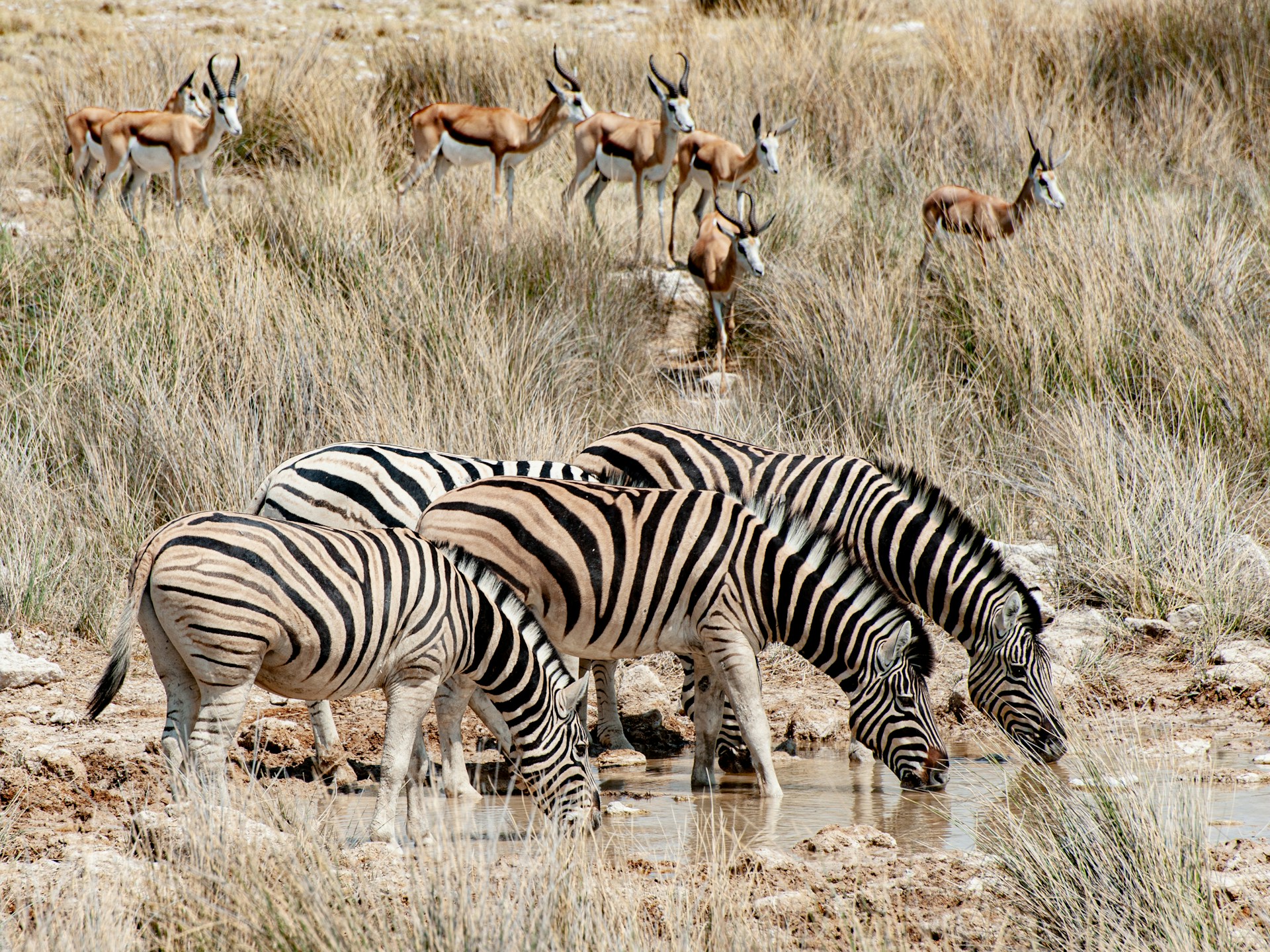
“The chance that a parasite’s necessary hosts overlap at a water body becomes elevated during drought. And when water bodies shrink to smaller sizes, parasites don't have to travel as far to find a host in the water,” said Stewart Merrill. “On the other hand, if a water body attracts hosts but dries up before transmission can occur, the parasite won’t be able to spread. We call these cases ‘desiccation traps,’ because the parasites can't get out to further their life cycles. In this case, the total net effect would be that overall infection rates go down.”
Impacts on host and parasite health
Droughts don’t just alter water quantity and distribution, but also its temperature, salinity, dissolved oxygen levels, and the concentration of nutrients and contaminants. These changes in water quality can help or hurt parasites. The impact depends on the parasite. Drought-induced saltiness can increase perkinsosis infections in oysters, for example, whereas it can reduce certain copepod infections in fish.
Likewise, water shortages and stress from high temperatures, salinity, and hypoxia can make hosts more susceptible to infection. For example, drier and warmer ponds can reduce frog immunity, making them more vulnerable to chytrid fungus infections.
Favoring drought-tolerant species
Droughts can selectively favor drought-tolerant parasites and hosts, changing aquatic food webs in ways that promote disease, the authors write. One example: mosquitoes.
“Drought will make a lot of water bodies smaller, and we know that mosquitoes love to breed in shallow, standing water like puddles and ponds,” Stewart Merrill explained. “By making habitats more suitable for mosquitoes, drought can increase vector abundance and therefore permit more infectious disease.”

Key takeaways and next steps
While effects will vary for different diseases, overall, the authors suggest that droughts will amplify parasites if they bring hosts together and increase overlap between hosts and parasites, as long as hosts and parasites are able to survive in the water that remains. Conversely, if the drought eliminates too many parasites, hosts, or water bodies, aquatic infections will go down.
Johnson and Stewart Merrill have already begun testing their framework in field experiments with multiple hosts and parasites in California wetlands. They hope this new paper will inspire other scientists to do the same, and to continue working to understand which parasites will be ‘winners’ and ‘losers’ in a hotter, drier future.
“Having expectations for when, where, why, and how aquatic parasites are going to become problematic is really critical for guiding disease prevention and management,” said Stewart Merrill. “Our framework helps to create a roadmap for predicting emerging diseases, which public health experts and land managers can use to inform monitoring strategies and prepare mitigation strategies.”
Funding
This work was supported by the Strategic Environmental Research and Development Program (SERDP) under Project RC24-4111: 101897.


