


Tick-borne diseases are on the rise in the United States. Lyme disease is the most commonly reported, with nearly half a million people diagnosed each year. Caused by the bacterium Borrelia burgdorferi, it is most often spread by bites from blacklegged ticks. Lyme can be treated with antibiotics, but if untreated, infection can spread to the joints, heart, and nervous system, and some people can experience persistent symptoms.
For more than 35 years, researchers at the Cary Institute of Ecosystem Studies in Millbrook, New York have been studying how interactions between acorns, rodents, ticks, predators, and climate shape Lyme-disease risk in people. A new paper, published in Proceedings of the National Academy of Sciences, details nine of the research project’s most surprising findings to date. Several are outlined below.
“On balance, these surprises have enriched our knowledge of this system, helping us to inform management of tick-borne disease risk,” said lead author Richard Ostfeld, a Cary Institute disease ecologist who co-directs the research program with Shannon LaDeau. Ostfeld added that many of the findings would not have been possible without the decades of data the project has collected so far, which helps the team to statistically distinguish real trends and drivers from random events and correlations.
“Studies of this depth and length are incredibly rare,” said LaDeau. “This research has followed an ecological community — including oak trees, mammals, and microorganisms — examining how interactions like predation, parasitism, and competition shape the system over time. The evolution of understanding summarized in this paper is something you simply cannot get without such a long-term and system-focused study.”
White-tailed deer are less important than previously thought
When Lyme disease was first recognized in the United States in the 1980s, some researchers assumed white-tailed deer played an important role in spreading the disease, because deer killed by hunters in the fall often carry large numbers of adult ticks. Although deer do not infect ticks with the Borrelia pathogen, the logic was that more abundant deer might feed more adult female ticks, which would then be able to lay more eggs and produce more immature ticks.
However, after several decades of intensive research, the long-term study on the Cary Institute’s campus — a forested ecosystem spanning 2,000 acres in New York's Dutchess County — has not found a statistical relationship between deer abundance and the density of nymphal ticks, the life stage of ticks that is most likely to spread Lyme disease to people.
“We had detected a weak positive relationship between deer and subsequent nymph abundance over short subsets of the data,” said Ostfeld, “but the whole data set in its entirety shows no such thing.”
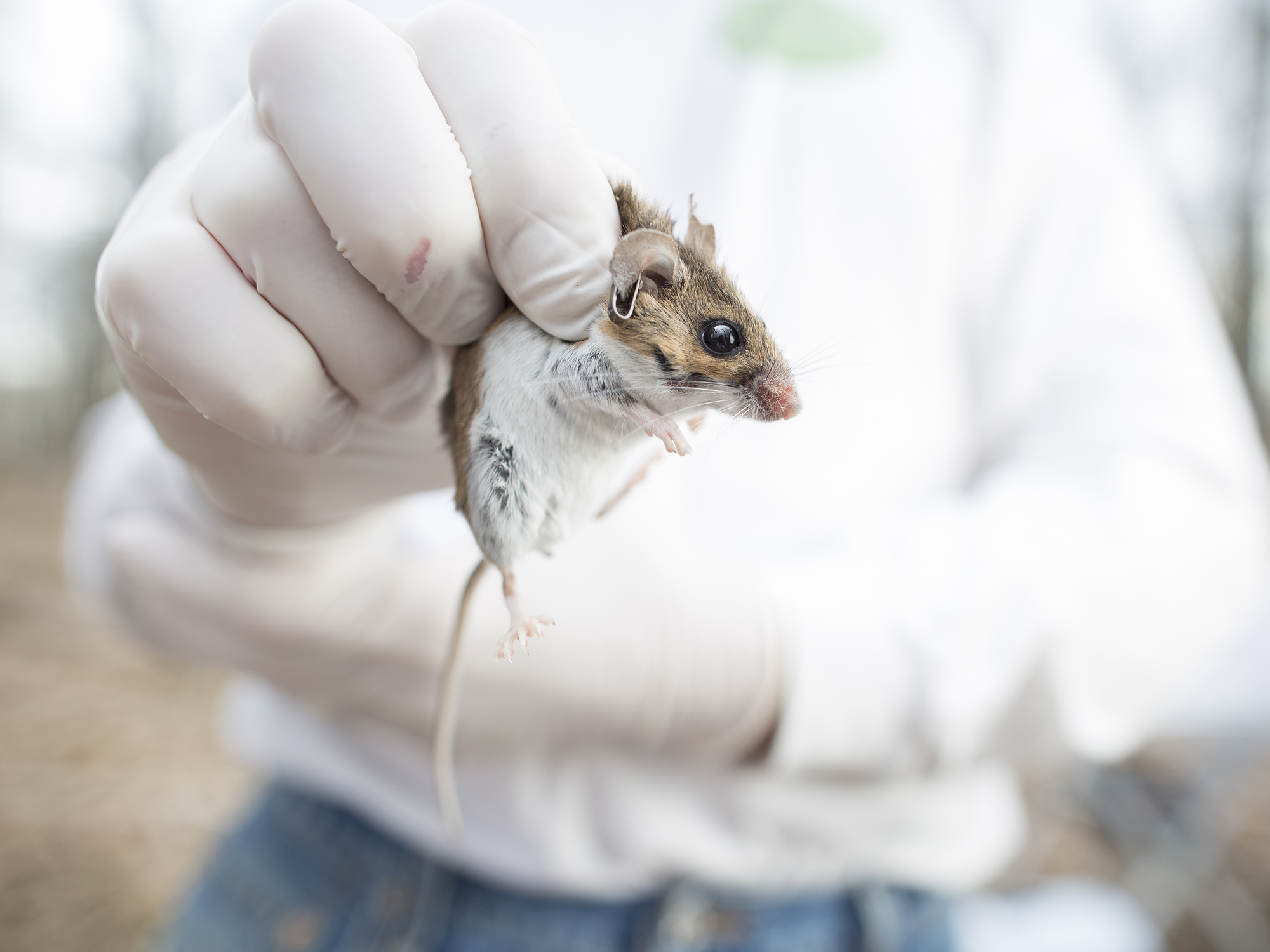
Mice matter more
While deer abundance wasn't associated with the number of nymphal ticks, mouse abundance was. The long-term study has shown that a strong mouse year boosted the next year’s number of nymphs by about 40%. White-footed mice are a high-quality food source for blacklegged tick larvae, and also happen to be very good at passing Borrelia burgdorferi bacteria to them.
Ticks that acquire Borrelia as larvae can transmit the bacteria when they feed as nymphs. This is the life stage that is most likely to infect people.

The acorn effect
The project has revealed that acorn masting — when a large number of oak trees drop their acorns at the same time — creates a food bonanza for mice, boosting their populations the following year, and nymphal ticks the year after that. Thus, a large acorn crop reliably predicts higher numbers of nymphal ticks two years later.
Mouse numbers don’t predict the proportion of Lyme-infected ticks
The researchers expected that, just as a large mouse population boosts the number of nymphal ticks, it would also boost the percentage of nymphal ticks that are infected, since mice are so good at transmitting Borrelia burgdorferi. And in the early days of the monitoring program, the scientists observed this trend. But as the years wore on, the relationship disappeared.
“It kept me up at night,” said Ostfeld, “because it meant that my understanding of how the system works was incomplete or wrong.”
Eventually, the data suggested an explanation. Even though mice might be more abundant in some years, other hosts — such as skunks, squirrels, and opossums — might be more abundant as well. Most of those hosts are not very good at spreading Borrelia to ticks, and thus reduce the prevalence of Lyme bacteria in nymphal ticks.
“So the infection prevalence in the nymphs really depends on how all the larval tick meals are distributed across all the hosts,” explained Ostfeld. “It would have been convenient if one host predicted that for us, but that has not been the case.”
Extreme temperatures don’t kill ticks in the wild
Lab work had previously suggested that blacklegged ticks are killed by extreme heat and extreme cold events, but Cary’s field studies found that in natural environments, the ticks beat the heat and cold presumably by sheltering deeper into soil and leaf litter. The team has, however, found a trend: years that are warmer overall predict lower-than-normal numbers of nymphal ticks. In contrast, warmer years are good for mouse populations, so this mix of effects will be important to continue monitoring.
Continuing the legacy
The big takeaways from the long-term monitoring program are that the ecological dynamics governing Lyme disease risk are complex but predictable. Knowing that mouse abundance, but not deer abundance, is linked to higher numbers of nymphal ticks — and that severe winter weather may not substantially reduce tick populations — can help public-health officials anticipate periods of elevated Lyme disease risk and guide prevention efforts.
There is still much to learn about ticks and the ecological variables that impact their chances of spreading diseases to people. In particular, one big research frontier will be sorting out how climate change is influencing ticks, their hosts, and oak trees.
“You would expect that a warming climate, which makes life better for the mice, would eventually make life better for the ticks, but we have not seen that so far,” said Ostfeld. “We need to know what to expect from the different manifestations of climate change, which are sometimes warmer and drier, and sometimes warmer and wetter. The time of year when it’s very warm also matters to ticks, oaks, and acorn production.”
Since the project began in 1991, the Dutchess County, New York study site has experienced climate change, landscape change, invasive species, and more. The authors plan to continue studying how ticks and their hosts respond to these evolving conditions, and how human health may be affected in the future.
Authors
Richard S. Ostfeld - Cary Institute of Ecosystem Studies
Shannon L. LaDeau - Cary Institute of Ecosystem Studies
Kelly Oggenfuss - Cary Institute of Ecosystem Studies
Charles D. Canham - Cary Institute of Ecosystem Studies
Michael Fargione - Cary Institute of Ecosystem Studies
Raymond J. Winchcombe - Cary Institute of Ecosystem Studies
Felicia Keesing - Bard College
Funding
U.S. National Science Foundation grant number DEB 24-32607 and DEB 25-38314.


